Operationsplan - Barbarossa
The German-Soviet theater of World War II was the largest land conflict in history, both in terms of space (square mileage) and manpower. When it started in June 1941 the combined strength of the two sides was around 6 million soldiers, and that would steadily increase until its peak at about 11 million in 1943. It's my favorite military campaign, and a fascinating one to consider from a "what-if" perspective. The Germans probably had no real hope of winning, but they made a number of serious operational mistakes and still managed to conquer thousands of square miles of Soviet territory.
Russia is big. Really, really big. Panzers are mobile and crave space; we will give it to them in bunches in Russia. In fact, when the Germans invaded Russia in 1941 they found themselves with so much space they literally could not figure out what to do with it all. Nowhere is this truer than in Ukraine -- the land there is vast, open steppes, in contrast with the northern areas which are densely wooded and broken up by the occasional marshland. So the southern front will be our ideal playground for mobile warfare, at least until the Soviets become competent at defending it by late 1941.
The goal however, is to annihilate the Red Army before that happens. Did I mention that Russia is big? The Soviets can afford to trade time for space, and they have an enormous industrial base. If the bulk of the Red Army is allowed to retreat into the Russian interior and remain intact, by mid-1942 it will have morphed into an unstoppable juggernaut. Historically, the Germans did manage to annihilate most of the Red Army as it was on day one of the invasion, and the Soviets still managed to morph into an unstoppable juggernaut by 1943. So we place primary emphasis on encircling and destroying Red Army units, all geographic/political objectives are secondary.
So what is it we want to do better than the Germans really did? Basically:
- Have more of everything available
- Plan/stockpile to support sustained offensive operations for at least a year, not eight weeks
- Have a plan for dealing with the winters
- Have a plan for supplying mobile formations deep in enemy territory where rail transport is not available
- Have a cohesive strategy for employing the mobile formations and stick to it.
The Red Army
The Office of Foreign Armies East has prepared a cursory report on the state of the Red Army based on intelligence gathered by other Axis members currently engaged (Finland, Spain, Romania, Hungary):

The middle column on the left half of the report tells us that the Soviets have somewhere between 415-677 divisions in the field. The average Soviet infantry division in World War II fielded about 5,000 combat soldiers, so a conservative estimate of 5,000 * 500 divisions = 2.5 million men. This is twice the number originally expected by summer of 1941 and the Wehrmacht will require a substantial expansion of the mechanized forces to compensate.
The Soviets are currently engage in three offensive wars:
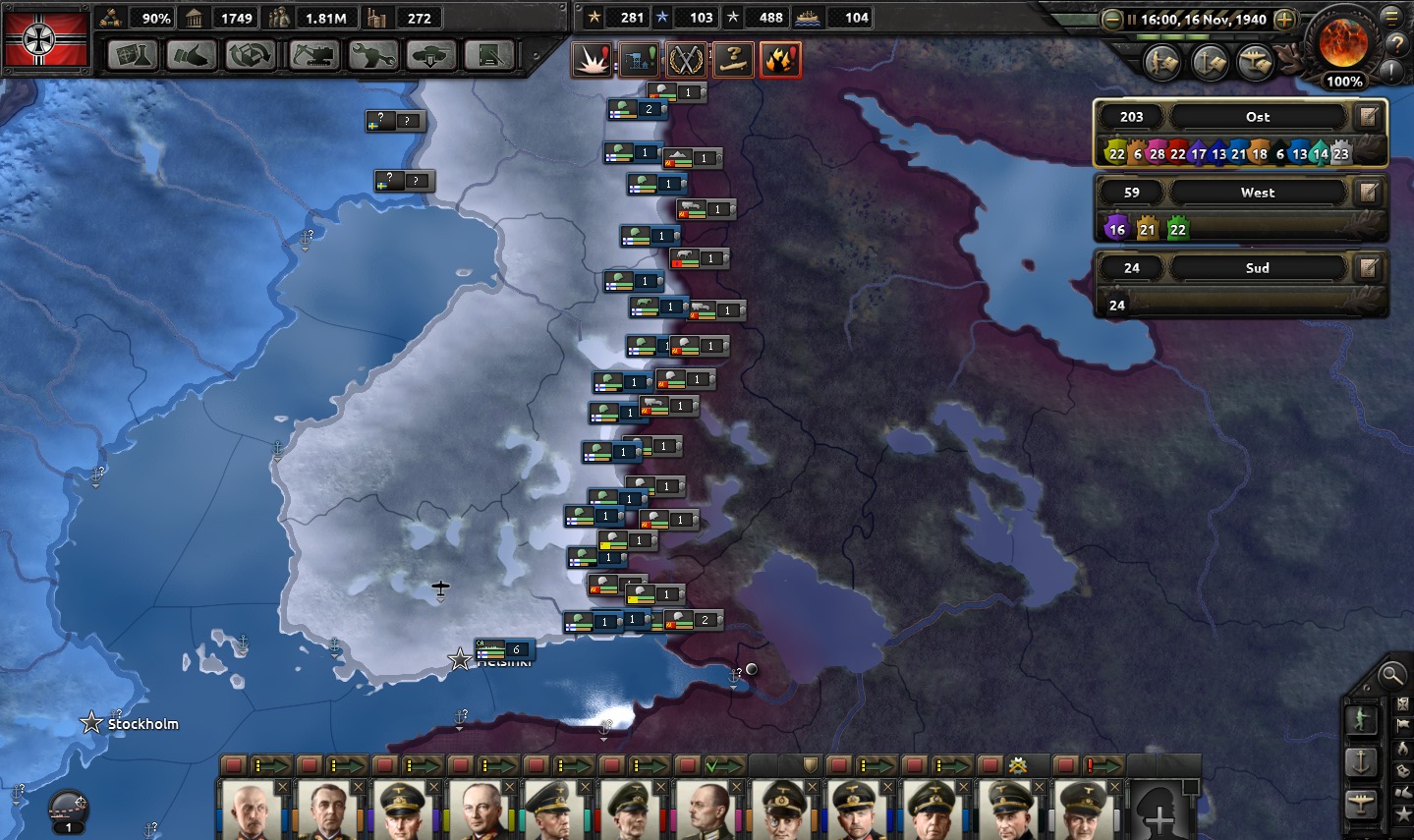
- Finland (far north, northwest of Leningrad)
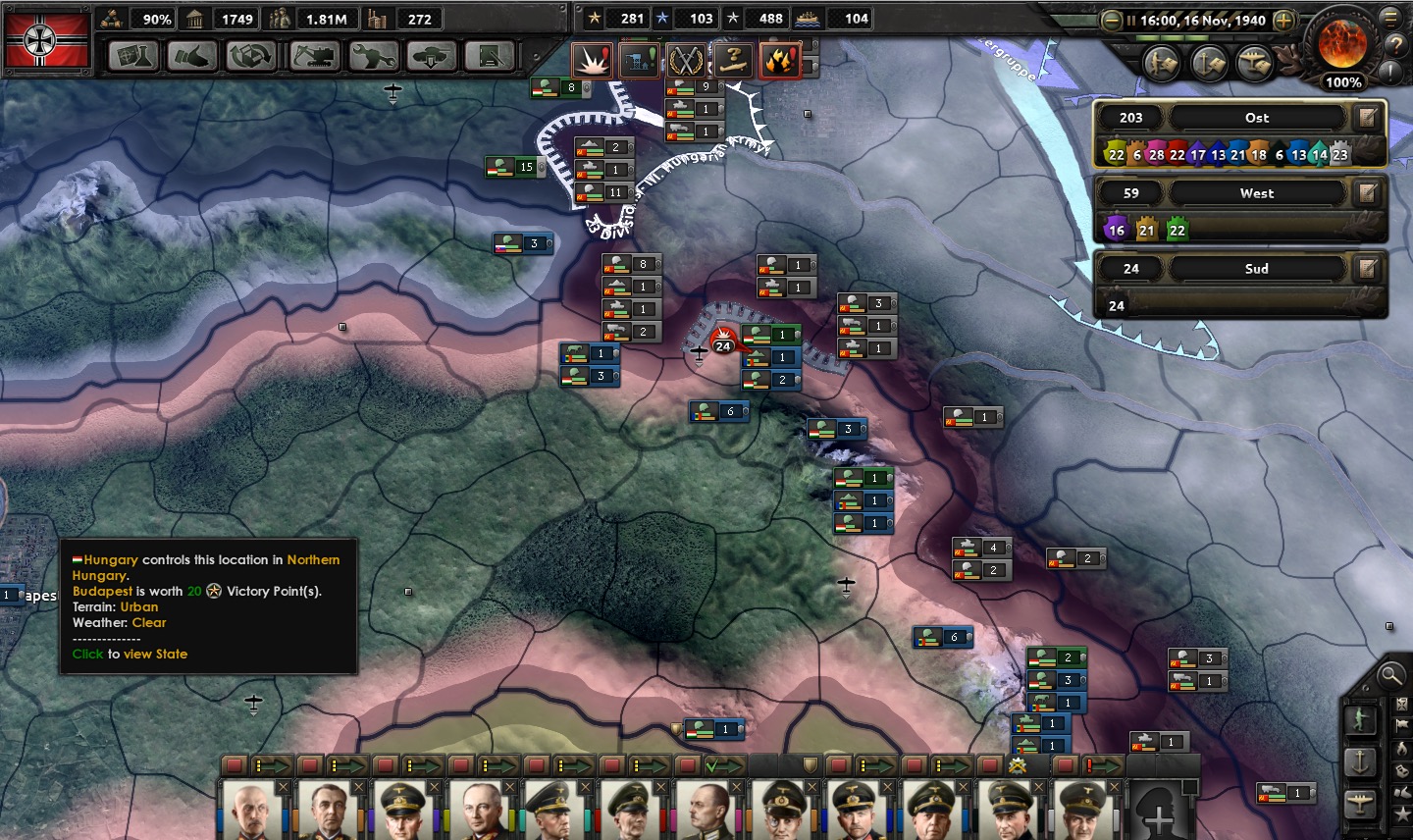
- Hungary/Romania (southwest front)
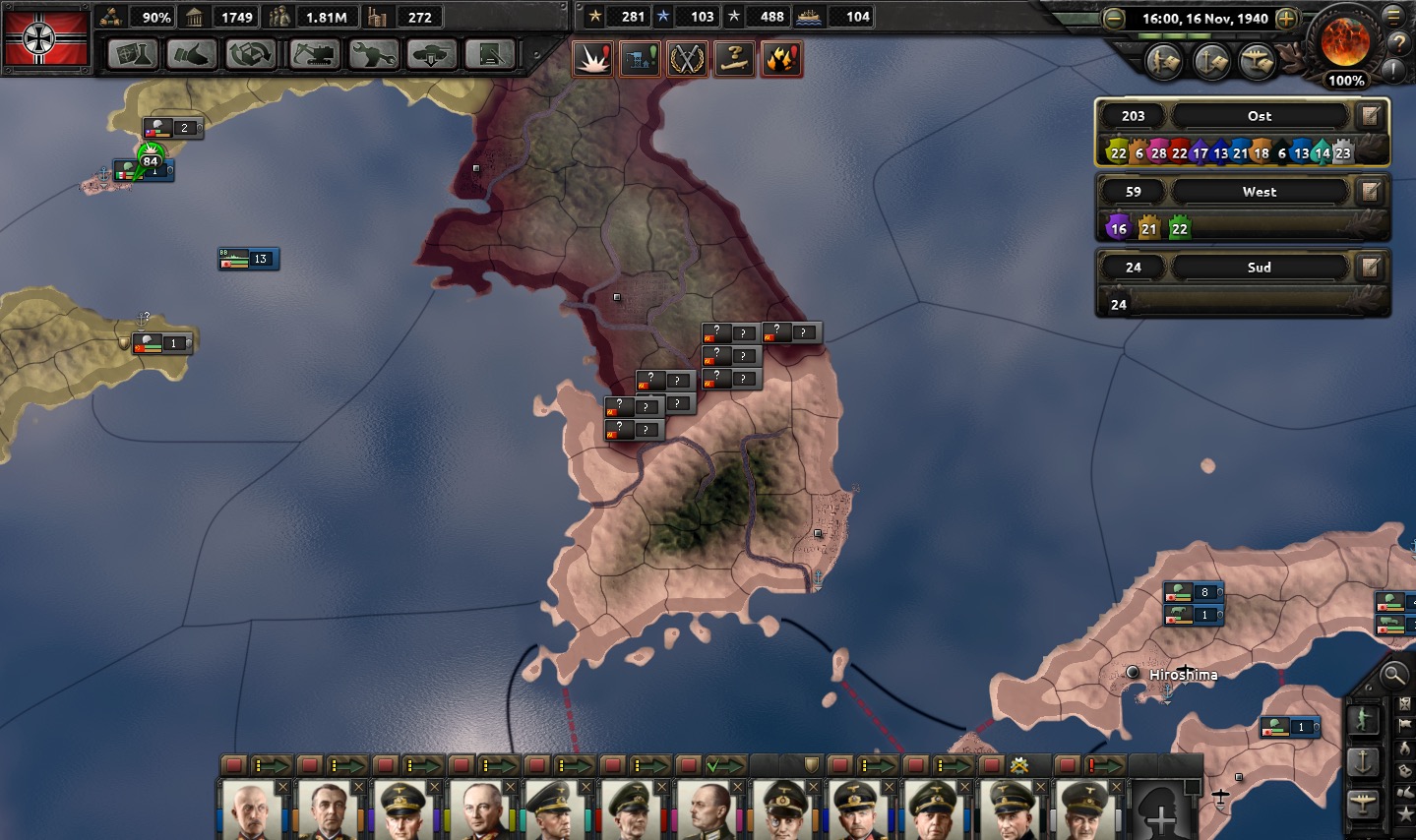
- Japan (far east)
The Soviets are committed but have failed to make much progress in Finland:
Meanwhile Zhukov looks to have had moderate success in flanking the Hungarian line in the flat terrain north of the Carpathian mountain range:
And they advance unopposed into Japanese-held Korea:
The Wehrmacht
The land forces of the Reich stand at 380 divisions, including expeditionary forces from the various Axis nations directly under its control. 85 of these are predisposed in defensive/garrison duties in western and southern areas and must remain there as we are under constant threat of seaborne invasion from England. The mechanized forces are 20 panzer and 13 motorized divisions split into three panzergruppen, with a fourth currently marshaling. Three new panzer divisions will deploy near the end of November. Matching the Soviets in terms of quantity is hopeless; we will rely heavily on mobile warfare and encirclement to marginalize the Soviet numerical advantage.

The plan
With these considerations in mind, OKH has submitted a formal strategic plan for Operation Barbarossa:
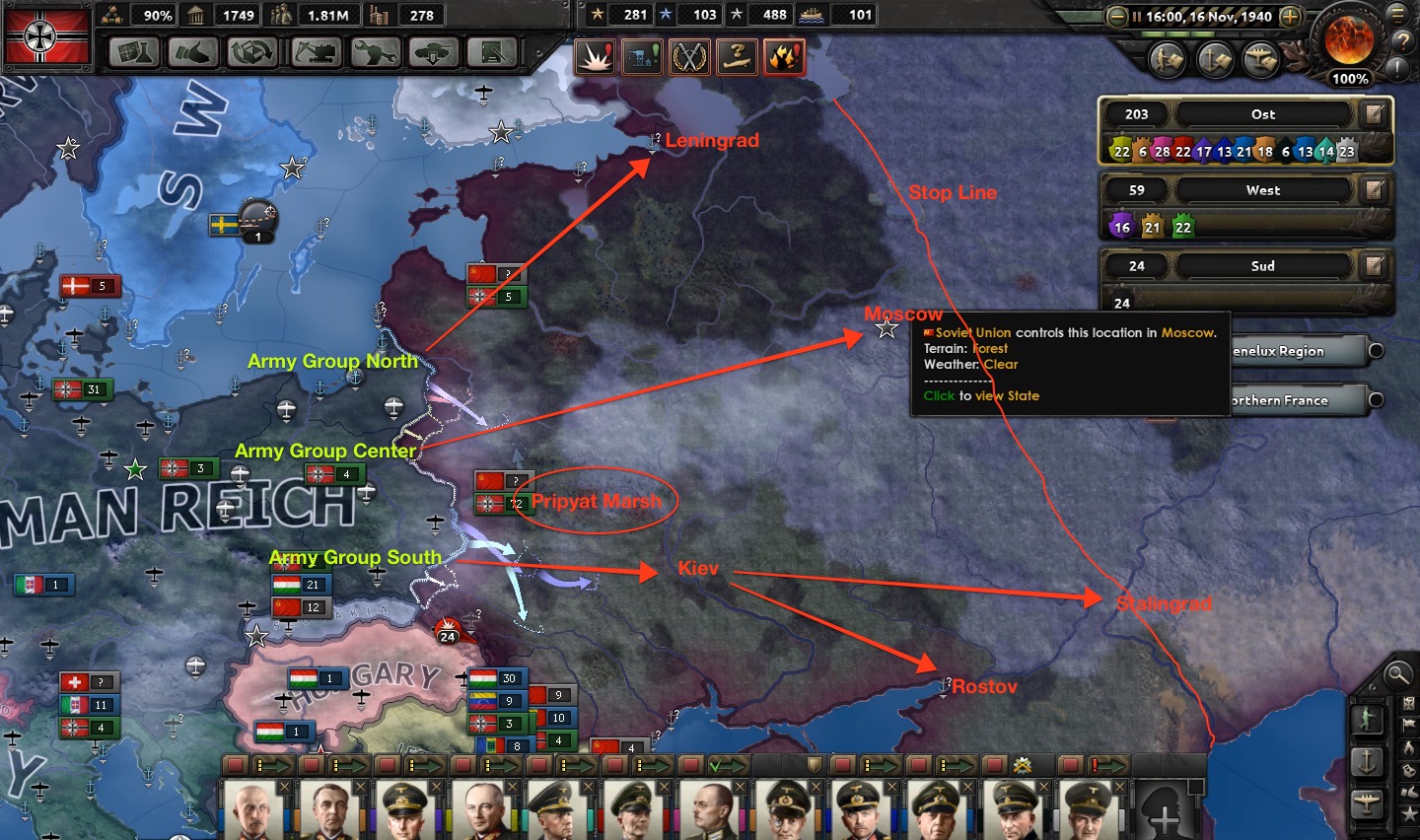
We partition the Eastern theater ("Ost" as highlighted on the upper right-hand side of the screenshot) into three army groups: North, Center, and South. Each army group will follow an axis of advance toward a major political objective, although the goal remains the destruction of the Red Army, not the capture of cities. Army Group North advances toward Leningrad, the cradle of the Bolshevik Revolution; Center toward Moscow by way of Minsk; and South through Ukraine, capturing Kiev before moving into the Don Basin toward Rostov and Stalingrad.
Army Groups Center and South will be separated by the impassable Pripyat marshland until they cross the Dnepr River, which runs north-south from Kiev up through central Belarus.
The idea is to press heavily in the direction of key Soviet holdings and force STAVKA (the Soviet high command) to decide where it wishes to commit the bulk of its strength. As enemy forces commit to a sector, we respond with deep penetrations by panzer groups on flanks aimed at encirclement. The infantry armies must reduce pockets quickly as we do not want mobile forces to sit idle on eastern edges of pockets; they must be free to continue into the Russian interior to prevent the enemy from forming a stable defensive line.
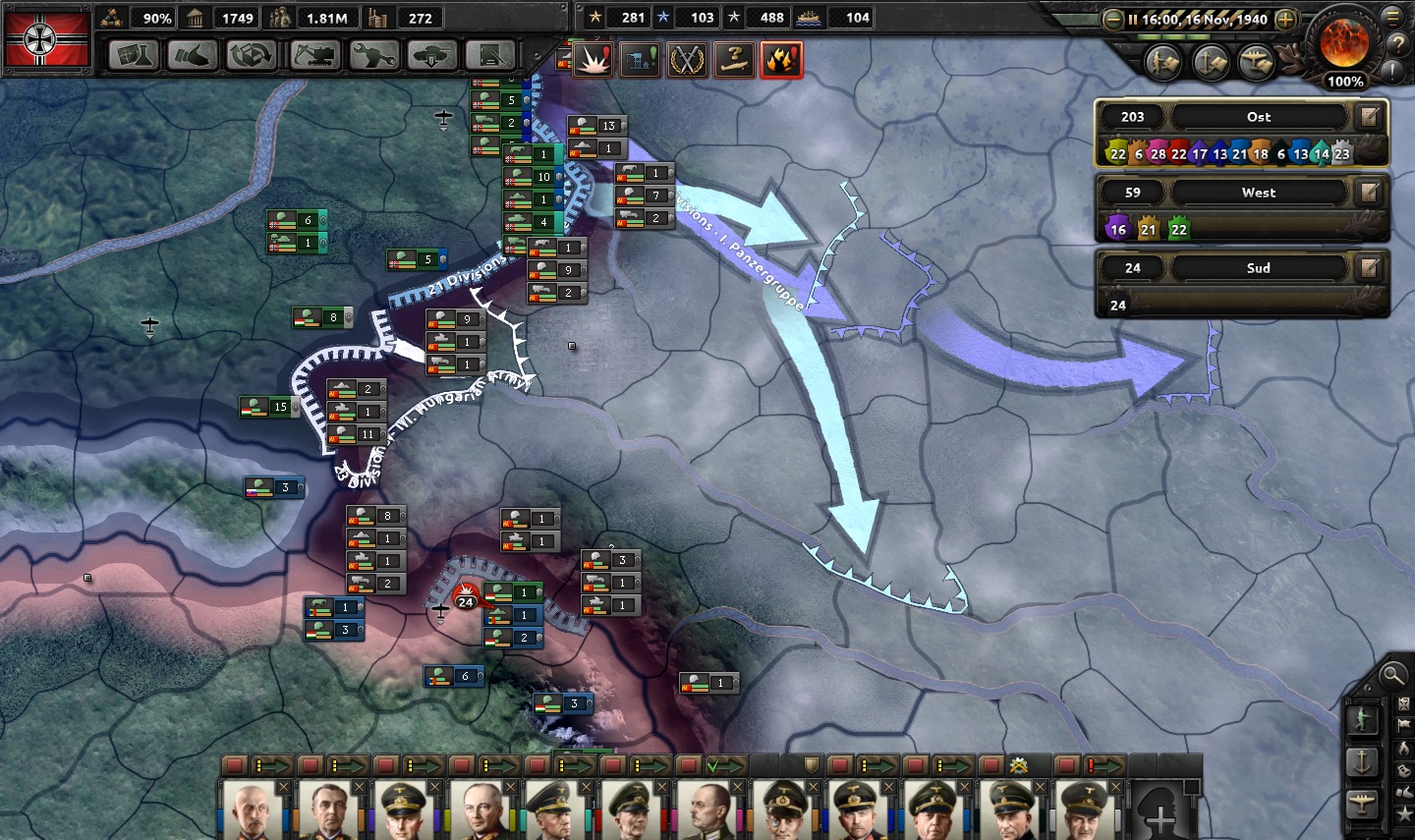
Rommel's panzer group will drive east and wheel south to cut off the Soviet forces advancing into Hungary. Guderian will follow Rommel through the breakthrough point and drive eastward, threatening Kiev. These moves will free up the Romanians to advance into southern Ukraine.

Army Group Center will execute a pincer movement with 2nd and 4th Panzer Groups, creating a large pocket centered around the Byalystok area. Once this pocket is reduced, the panzer groups will rinse and repeat with a link-up point somewhere east of Minsk.

A decisive battle will be fought to cross the Dnepr, the major river flowing just south of Smolensk (highlighted) and turning south in the direction of Kiev. We then consolidate in the Smolensk area and prepare to fight a battle of annihilation on the western approaches to Moscow.
Army Group North's approach to Leningrad is densely wooded terrain not as suitable for open mobile warfare. It will be allocated whatever new panzer forces we can marshal in time, but the bulk of the armor will be in the center and southern domains.
Logistical concerns
Infrastructure and road networks in western Russia are extremely poor; most roads are of the dirt variety and will be muddy quagmires during the rainy seasons in late fall and early spring. The Soviet rail network uses a different rail-gauge standard than ours, rendering our locomotives and rolling stock useless for resupply in the early months of the campaign. Engineering units can convert railroads to standard gauge, but that will take time. We will be heavily reliant on trucks to keep gas and supplies flowing to forward armored units, but most of the truck models in our motor pool are not designed for long-distance travel over poor roads. The attrition rate in the motor pool will be high so the Reich has prioritized the production of trucks and vehicle equipment:
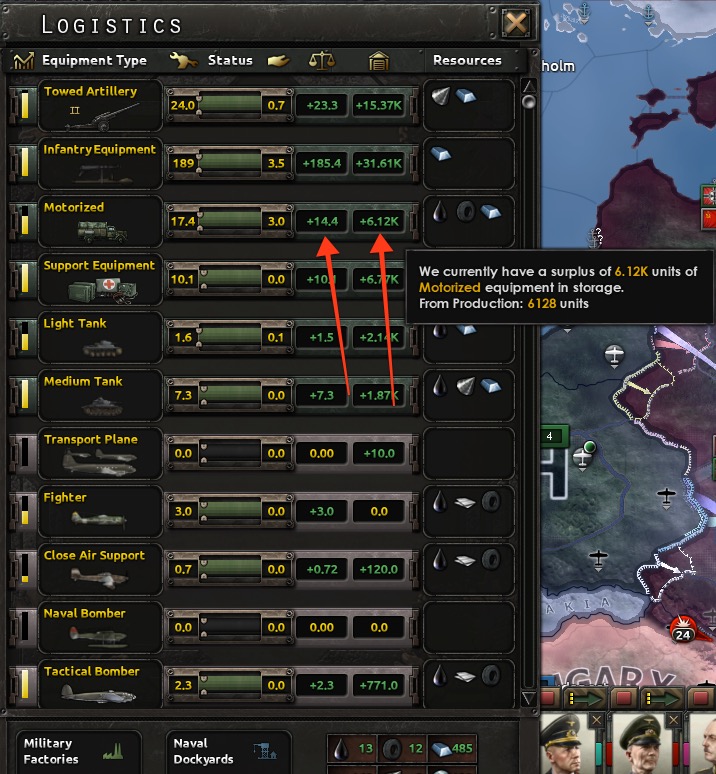
We currently produce 17.4 new trucks per day (losing 3 per day in field operations, for a net of 14.4), and maintain a reserve of 6.12K trucks in the motor pool (this does not include trucks already assigned to active divisions). The Reich relies on foreign imports for both oil and rubber for this production, and oil imports will be substantially reduced after Barbarossa begins because Russia is our largest foreign supplier.
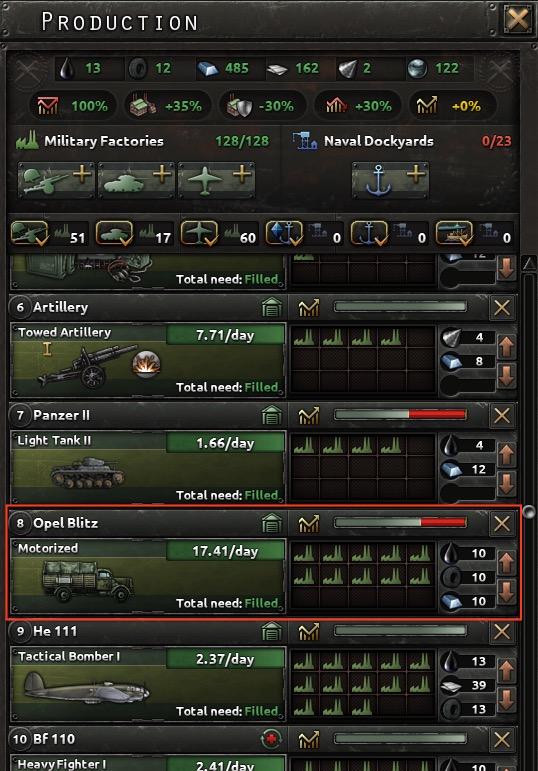
We have one "production line" with 10 factories dedicated to truck production, with another five slots open should we want to increase the output of this line. If this is insufficient we can open another parallel production line but we will have to pull factories off of production lines for other equipment to do so.
We must be careful to balance the need for panzer forces to continue forward against our ability to supply them in forward areas; historically this doomed Operation Barbarossa from the start. Army Group Center was not able to move forward fast enough, and could not make the final assault on Moscow until the early onset of winter; mobility advantages were nullified and conditions swung decidedly in the Soviets' favor. After November 1941 the Wehrmacht lost permanently the ability to conduct sustained offensive operations with more than a single army group at a time; by late 1942 it had lost the initiative altogether. It is critical that we effectively finish the war before the end of the summer campaign season in 1942.