January 1936
The game opens in January of 1936. The Reich starts on a decent economic footing, having emerged from the troubles of the post-World War I period. We have an adequate industrial base and a sizable manpower pool (1.31 million) with which to begin building up the Wehrmacht. As we are currently at peace, we are not currently on a war footing either in terms of conscription levels or use of civilian infrastructure -- so more resources will become available as we become more belligerent.
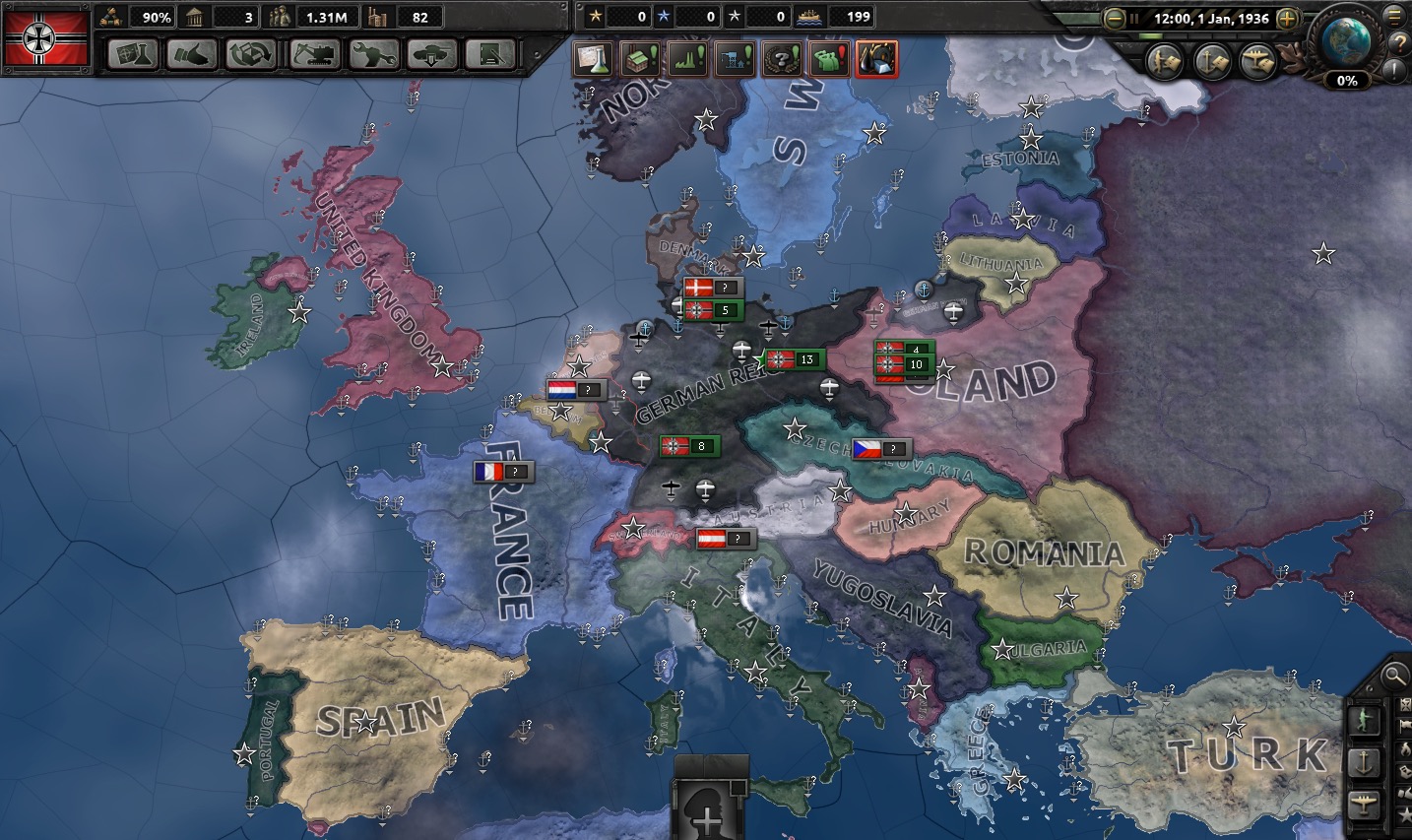
The game has a notion of "world tension" which increases as a result of things like military hostilities and aggressive diplomatic actions. This mechanic seems to be in place to prevent large powers like the USA from initiating large build-ups in the early game, because their populations and governments would not support it.
You can also spend "political points" (a la Stellaris) to perform administrative actions, such as appointing ministers to give bonuses. Another important thing to spend these points on is the "national focus", which is an abstract thing that can also yield bonuses. On day 1 we have selected the "Remilitarization of the Rhineland" focus, which represents the German reoccupation of that territory and seizing of its industrial assets (you can see the area on the western edge of Germany, surrounded by a red border). It will take about two months to complete, and doing so will both increase world tension and anger western powers like France and the UK.
In 1936 the German armed forces are in a sorry state. The land forces are as follows:
- 24 infantry divisions
- 3 panzer divisions (light panzers)
- 2 motorized divisions (truck-mounted infantry)
- 1 cavalry division
- 1 mountain division
For a grand total of 30 divisions. The Fuhrer has decreed that we should increase this number to 50 divisions by 1938, and 90 by 1939 (when we are slated to begin "Case White", the liberation of Poland). Using history as a guide, we should be prepared to carry out Case White with at least 60 divisions; we can expect the Poles to field roughly 40 divisions, consisting almost exclusively of infantry and light cavalry. OKW plans to field a minimum of 6 panzer divisions, divided into two corps, with each supported by motorized infantry. Formal operational planning will be handled by the OKH (Oberkommando des Heeres, or High Command of the German Army) for submission by mid-1938.
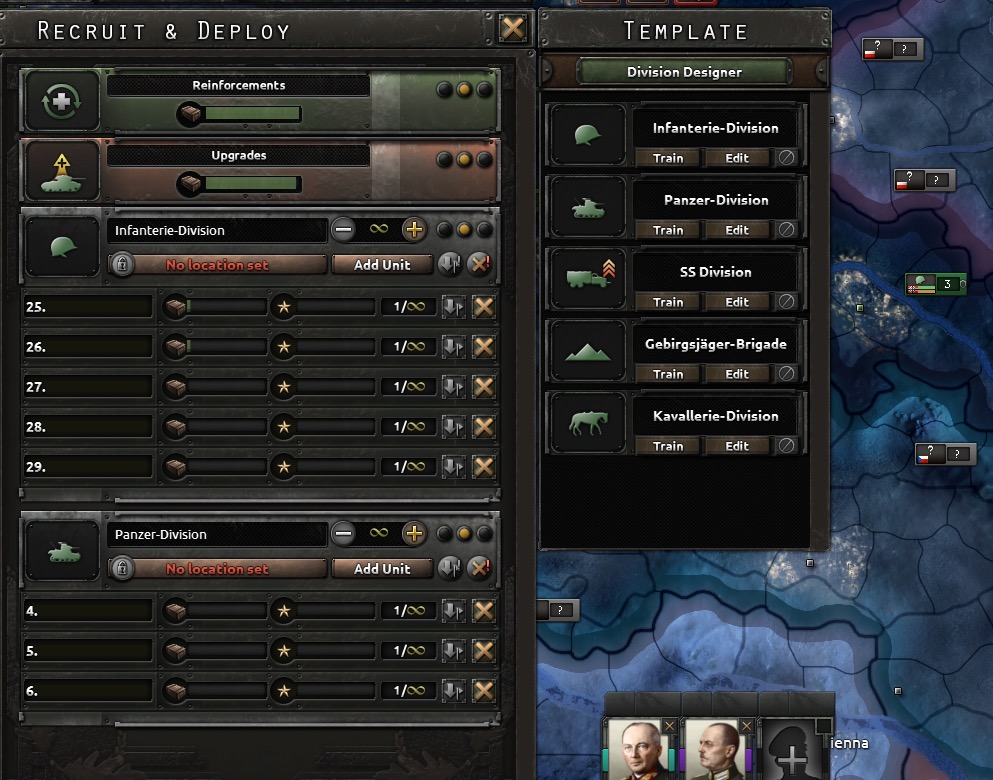
We've begun marshaling new divisions toward our 1938 goal, as shown in the screenshot above. We produce infantry divisions in "lines" of 5, where each line produces units in parallel. Additionally we are producing panzer divisions in lines of 3. We've begun researching medium-tank technology (the Panzer Mk. II) so we will be outfitting these new divisions with these machines when they become available.
Divisions organized themselves by drawing from (1) the manpower pool, and (2) the equipment pool. Military factories must be directed to contribute to the equipment pool, which contains everything from rifles and uniforms to tanks and planes. Once a division reaches a minimum threshold for both men and equipment, it will begin basic training; once training completes, the division becomes available for deployment.
Both manpower and equipment pools are also used to supply replacements to units in the field, so we will want to build up a sizeable surplus in both prior to 1939.
Germany is short on two key resources required for equipment production to arm its forces: oil and rubber. In order to address this, we've made the following trade deals:
- Soviet Union - oil
- Romania - oil
- Brazil - rubber
It's not quite clear to me what we are giving up in return for these deals, but concluding them required us to remove civilian factories from our national pool.
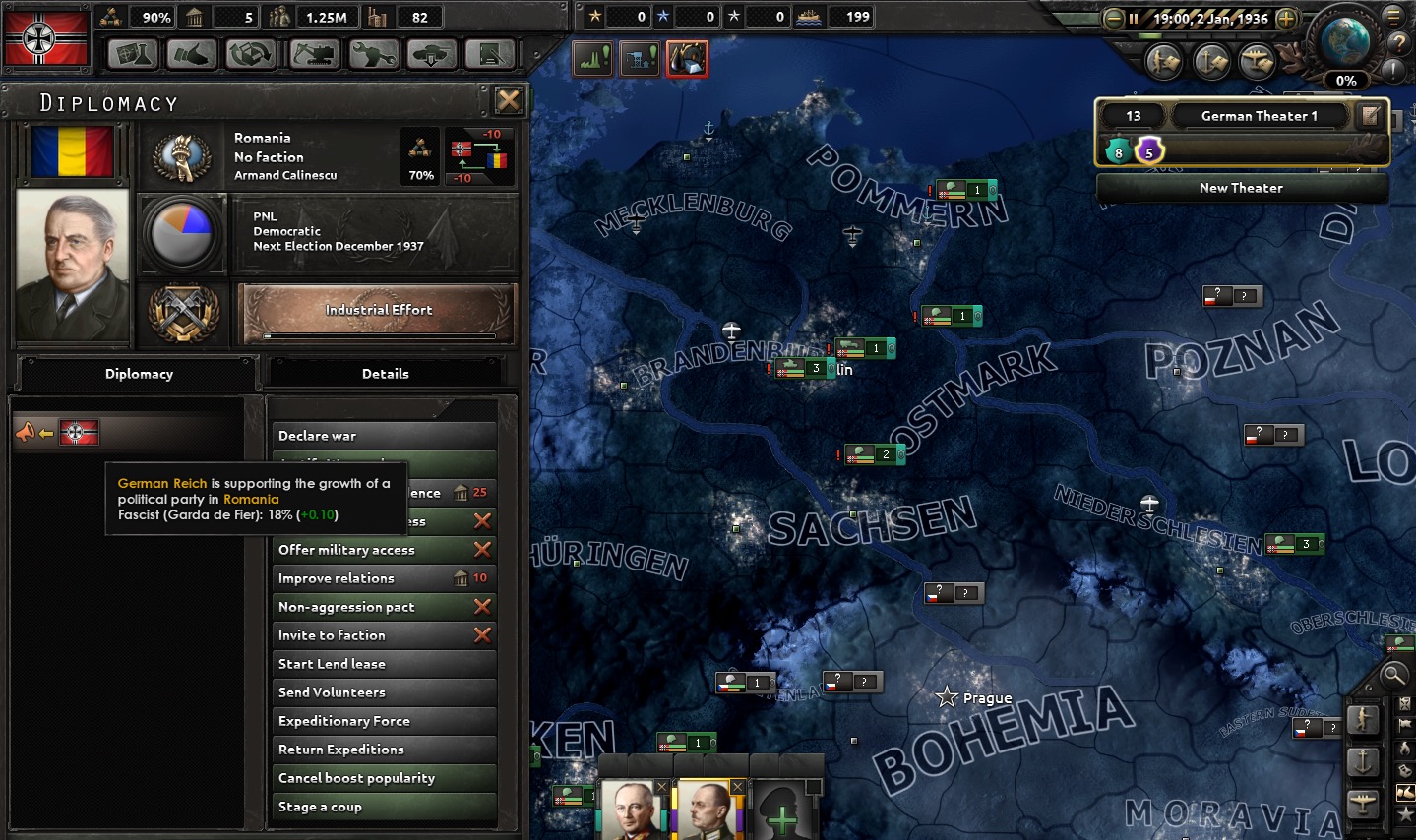
The screenshot above shows our master plan for long-term oil production: we will bring Romania into the Axis fold by increasing support there for the NSDAP political party. This has the effect of moving them toward the Axis faction. (Romania has large oil fields in the Ploesti region that we want.) The deal with the USSR is a temporary measure; we cannot rely on that long-term as we plan to invade them by 1941. Part of the motivation for that is the seizure of large oil fields in the Caucasus region, so if we succeed there we will be fully resource self-sufficient.