Case White - Outbreak of War
As expected, Poland refused our demands. Case White launched around June 25, and initial progress was quite good:

Guderian has punched right through in the north, and Panzer Group 1 steamrolls southward across open terrain east of the Vistula River and Warsaw. Meanwhile Manstein's group to the south advances, although the Polish concentration there is stronger so progress is slow. The Reich enjoys complete air superiority.

Around midnight on June 27, Rommel's Fifth Army seals the mini-pocket around Danzig. 4 Polish divisions are trapped there, and Rommel will press ahead to the southeast while 2nd Army collapses the pocket.
Here's a closeup of the south at the same time:
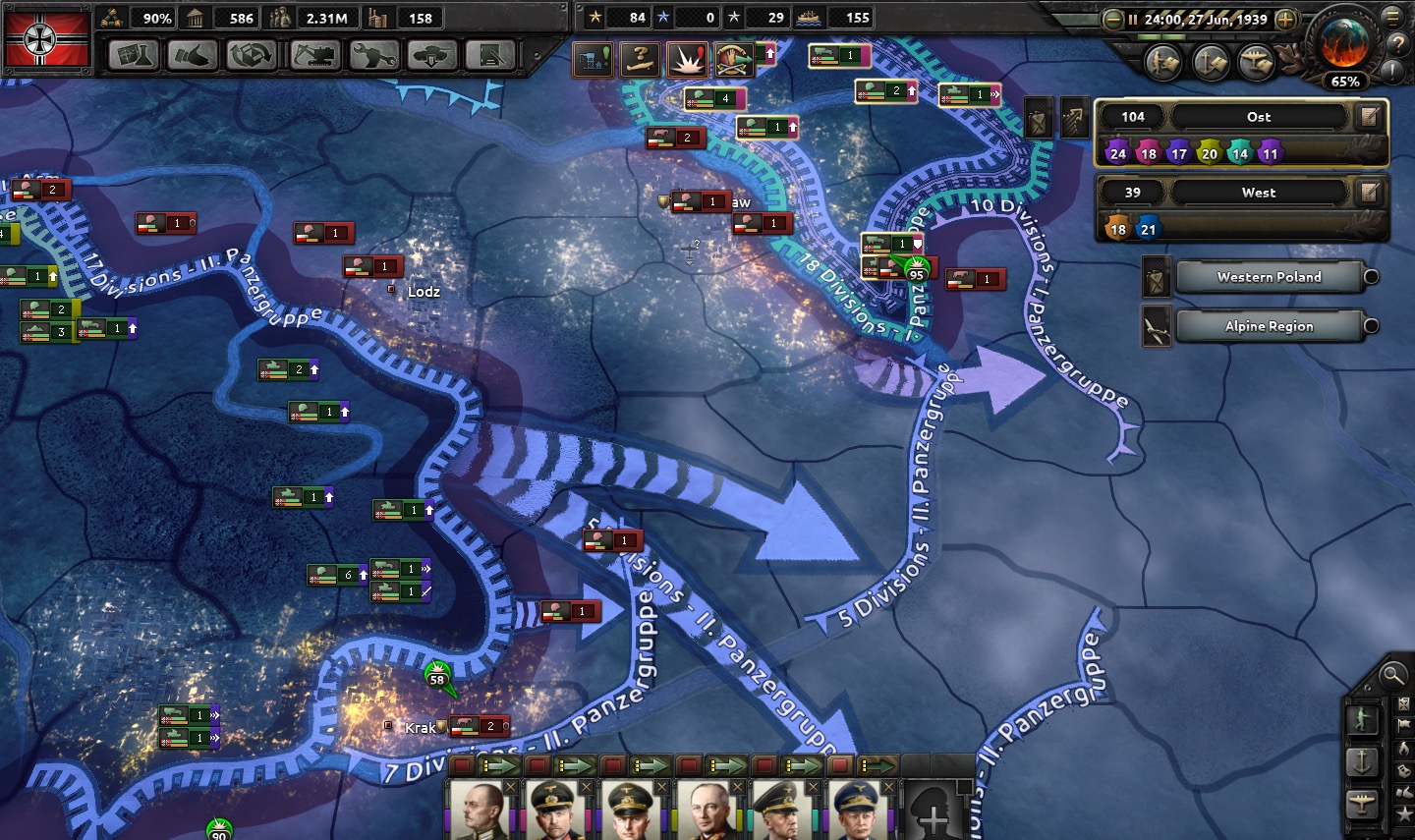
Resistance is disintegrating in front of Manstein, and Guderian prepares to wheel eastward and hold the forward line.
Five days later on July 2, Panzer groups 1 and 2 have linked and encircled a massive contingent of Polish infantry. Our infantry armies hammer on the encirclement from the west, and only 9 Polish divisions remain there:
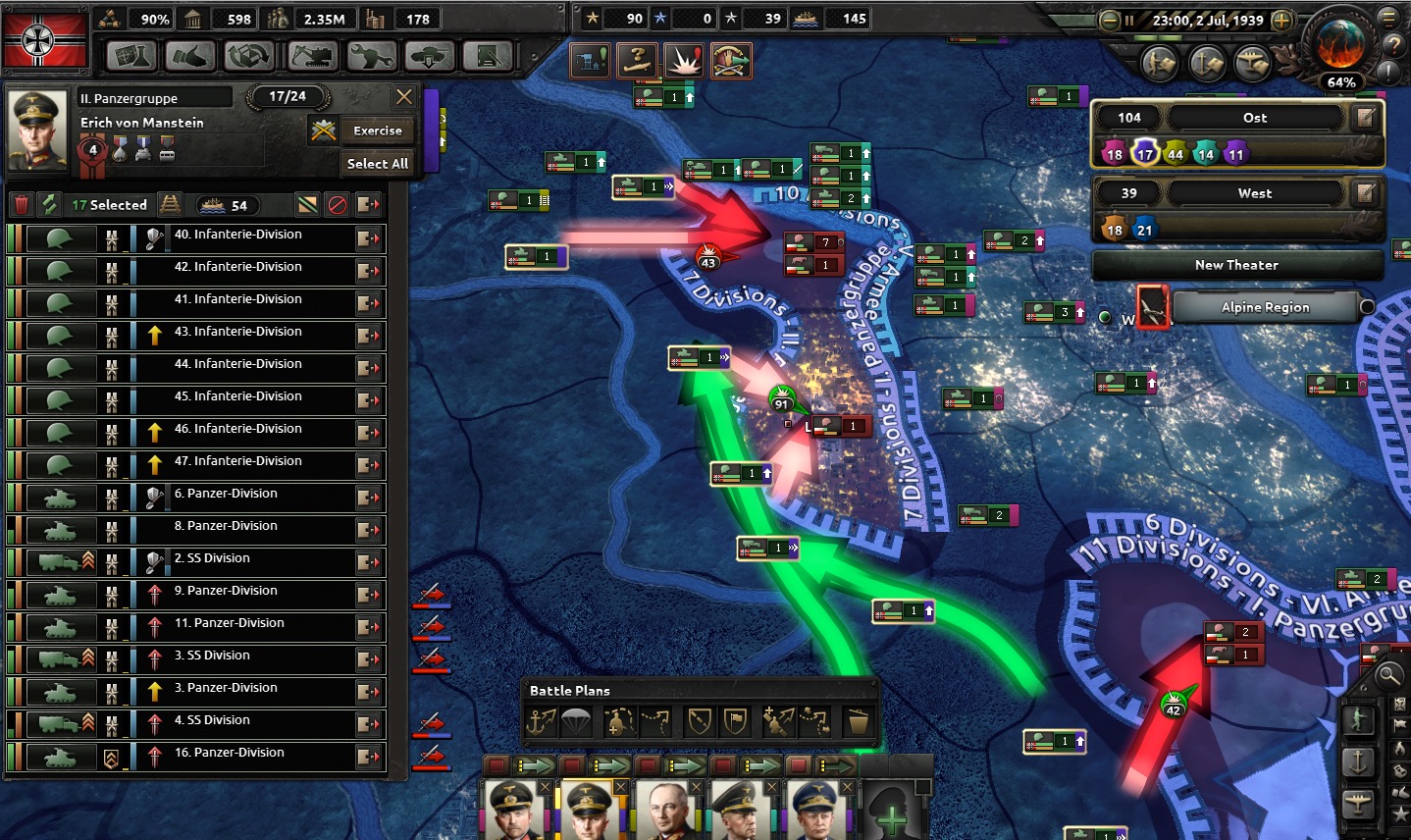
Overall the AI did a good job of carrying out the plan, but one major annoyance was Guderian's panzer group inexplicably turning westward and crossing the Vistula to attack Warsaw. I was really hoping to avoid using armor to attack the city, but by this point resistance was so disorganized it didn't end up costing us too much.
By July 7, we have consolidated along a line east of Warsaw. Guderian and Rommel have concentrated to the northeast of the city and launched another deep penetration aimed at cutting off the 15 or so Polish divisions holding out in the far south.
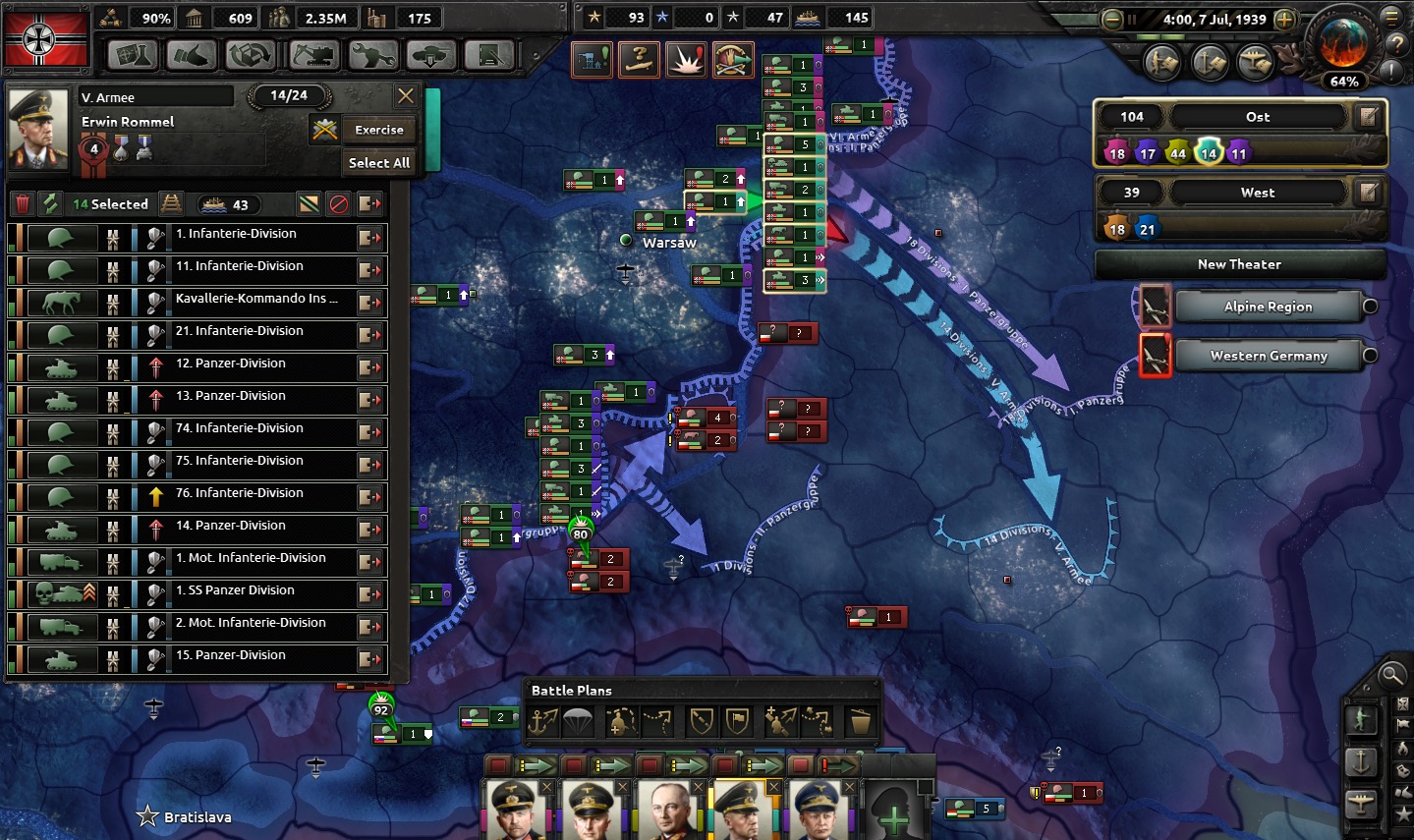
Meanwhile, there are some unexpected developments on the western front: the Luftwaffe is really struggling to preserve air superiority over northwest Germany, and we have received reports that the British are launching a sea invasion (!) in the neighborhood of Hannover:

We will have to wrap up the Polish campaign with the utmost urgency as we are not prepared to deal any sizable threat here. Since we have chosen to neglect naval rearmament, the Kriegsmarine has little hope of stopping the mighty Royal Navy from landing units anywhere along our coastline. Lesson learned!
Surrender and the pivot westward
On July 12, the Polish government succumbs and surrenders to the Reich. We are now free to reallocate the bulk of our forces to the west to deal with the British. There has been a lot of movement by the French along the Maginot line, and it is beginning to look likely that we will need substantial reinforcements on both flanks of our western defensive line.

The Reich after the incorporation of Polish lands to the east:
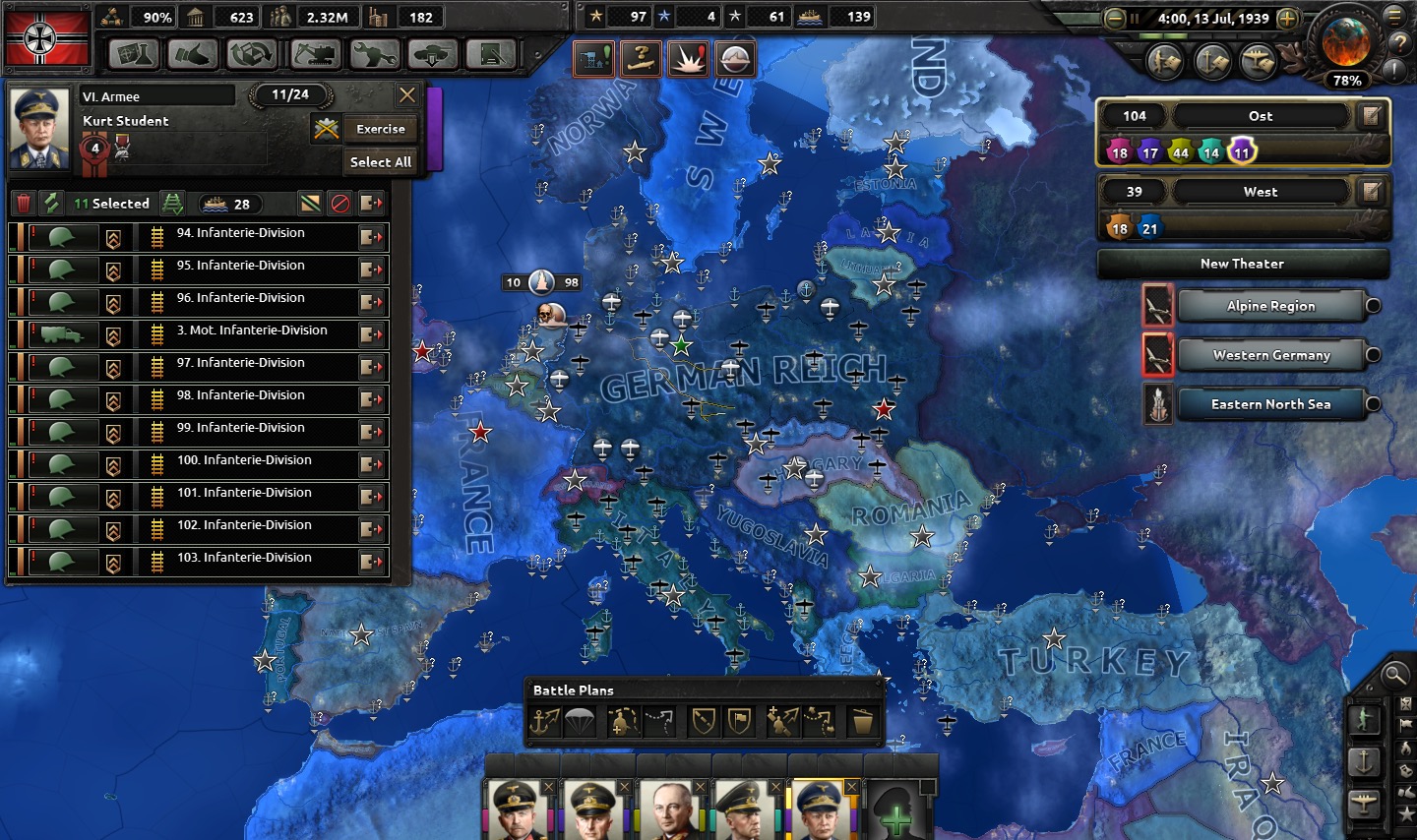
British disaster at Wilhemshaven
6th Army and 1st Panzer Group arrive by rail on July 20 to deal with the British landings in Weser-Ems. A sizable beachhead has been established around Wilhemshaven, with 21 British divisions there trying to roll up the right flank of our western line. However, 6th army forms a perimeter to contain the outbreak and the panzers make quick work of them:
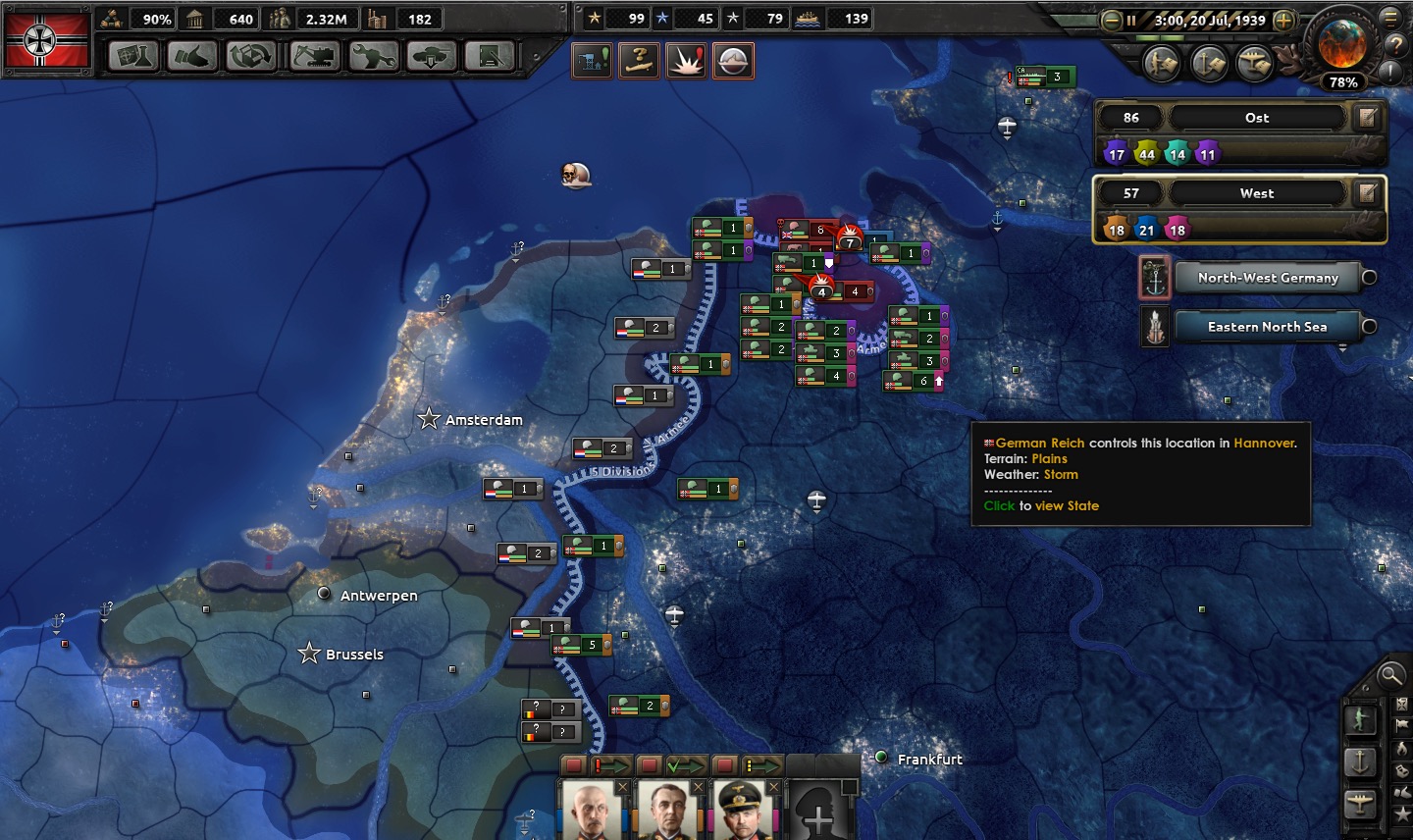
The counterattack moves ahead with such speed that the Royal Navy is not able to evacuate its units in time, and 1st Panzer Group inflicts over 150,000 casualties in its drive to the sea.

The lopsided casualty ratio shows how effective the Blitzkrieg-encirclement strategy can be. We use the mobility and firepower of armored units to devastating effect, inflicting huge losses on the enemy without having to resort to costly, low-return frontal assaults. We only lose 6000 men, compared to over 300,000 for the enemy.
Overall Case White is a resounding success, but serious problems linger in the west. The Luftwaffe is fighting a losing battle for control of the skies over the homeland, and this will have serious repercussions for both our continued rearmament (Allied strategic bombing) and our plan for the invasion of France, which may not succeed without air superiority.