Operationsplan - Seelöwe
By October of 1945, High Command is satisfied that it has a sufficient pool of convoys with which to initiate Operation Sealion. Thus OKW has submitted a formal operational plan:
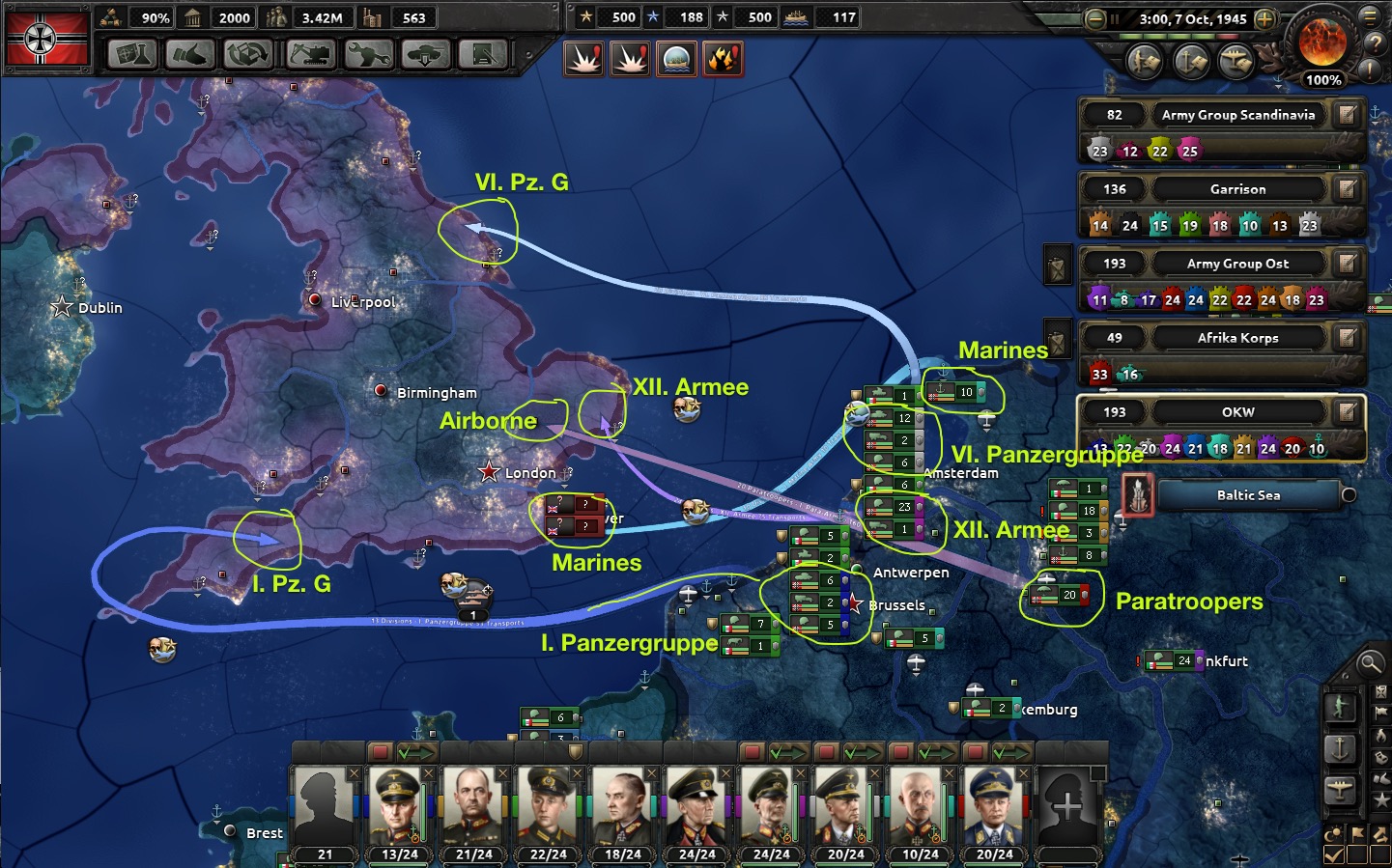
As described informally in the earlier directive, the assault will be split into five elements, each with different landing points. Panzer Groups I and VI will land on the "flanks", with each looking to strike out early to secure a deep-water harbor; meanwhile 12th Army will land in East Anglia. 20 Fallschirmjager (airborne) divisions will land just northwest of London to create a diversion for 12th Army, and to cut off the flow of men and materiel between the landing points for that army and the marines to the south at Dover.
It's very likely that one or more of these landings will fail; however, we only need one to truly succeed. The crucial early-stage goal will be the acquisition of a deep-water harbor with a naval base, without which we cannot open a flow of supplies and reinforcements to the island. Until we have a port for the heavy stuff, units will be operating on borrowed time and will be mostly left to work with what supplies they have. If no port can be secured within the first month, the entire invasion force risks annihilation.
The Reich produces warplanes at breakneck speed, and the Luftwaffe intensifies its pounding of the British Isles and Allied naval patrols:

The numbers in the bubbles over each "air zone" above are absolute plane counts. Roughly 4500 planes are involved in sorties over lower England alone; if we take all air zones into account in the region, the Luftwaffe dominates the skies with over 10,000 aircraft. Allied naval patrols do not dare make their way through the Channel or the North Sea for long, lest they be overwhelmed. American carrier groups lurk in the Western Approaches, but their airpower advantages are largely nullified by our strong fighter presence.
The airpower advantage also gives us continued naval supremacy east and south of the British Isles:
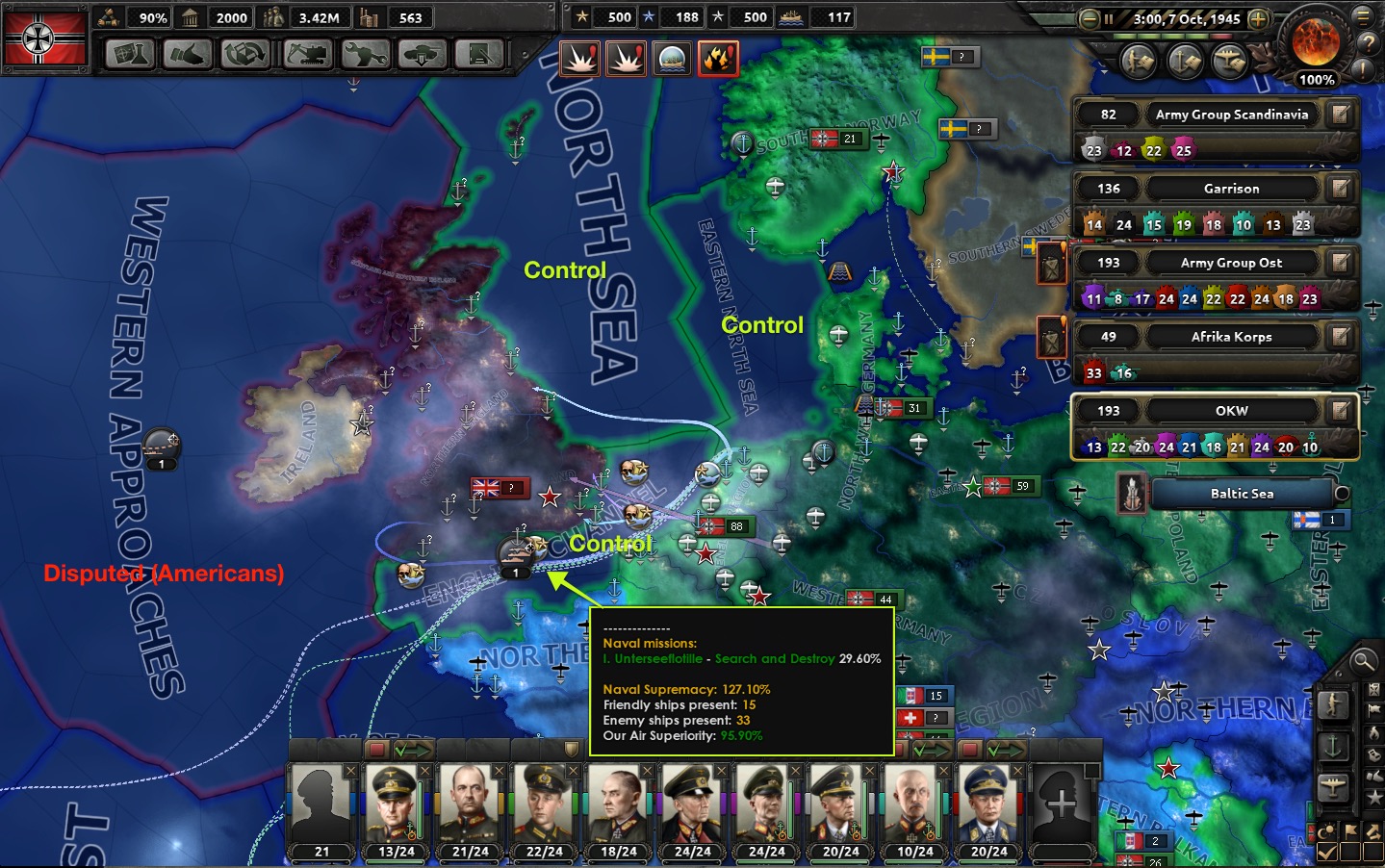
Sub packs continue to operate here, with a heavy emphasis on targeting enemy supply convoys. We still struggle to establish complete control over the Western Approaches, which is only in range of our westernmost air bases on the continent and a bit of a safe haven for US battle groups.
How strong are the British?
The game gives a bit of information here (though not much). We can't see much feedback regarding how effective our strategic bombing/convoy raiding campaigns are, but we do get absolute counts on enemy resources and force breakdown:
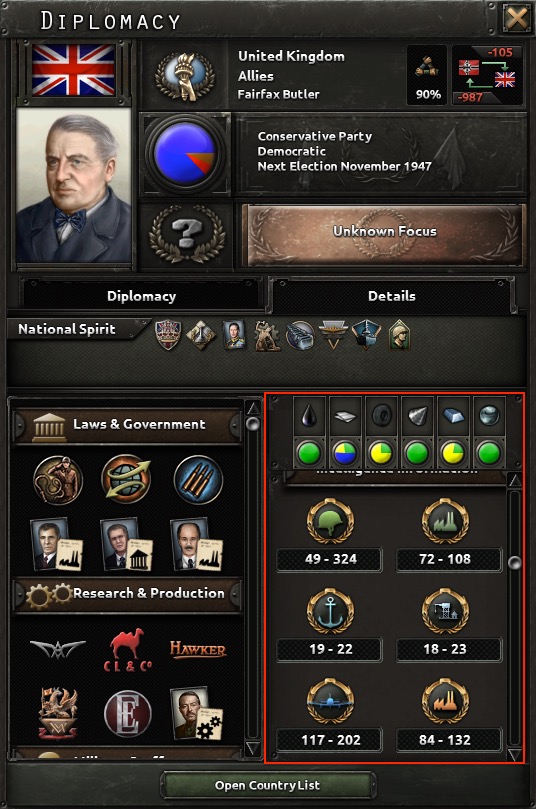
Resources. Near the top of the portion of the screen squared in red are resource pie charts. The green in each is the percentage of total output that is produced and consumed directly (domestically); the yellow portions indicate exports; the blue indicate imports. We can infer here that the British are short on aluminum, though they still do some exporting for some strange reason. Rubber is still in abundant supply, mostly due to production in far-east colonial holdings; however oil, tungsten, and chromium are all in short supply as well.
Military capabilities. The icons just below, from top left to bottom right, are:
- Divisions (land units)
- Military factories
- Naval ships
- Naval dockyards
- Aircraft
- Civilian factories
While the margin for error on the divisional estimate is too large to be useful at all, the English do appear to be very short on both ships and aircraft. The Kriegsmarine now outnumbers the Royal Navy, and the RAF is virtually nonexistent. They are totally reliant on the Americans for sea and air power, which must be projected all the way across the Atlantic; our ships and planes are never more than a few miles away from home base.