May - Repivoting
May 1942 - the Russian winter is a distant memory, and the muddy Rasputitsa season is quickly receding. The Wehrmacht has come through the poor-weather months in excellent shape and ready to finish off the Eastern campaign once and for all. Supply has been the only obstacle in our way, but in the south where the weather is generally better, progress has been extremely good. The Red Army is a shell of its former self and is no longer capable of standing in our way, anywhere.
As the Soviet Union's days are numbered, we again begin to cast our gaze back westward. But first, updates on the operational situation in the East:
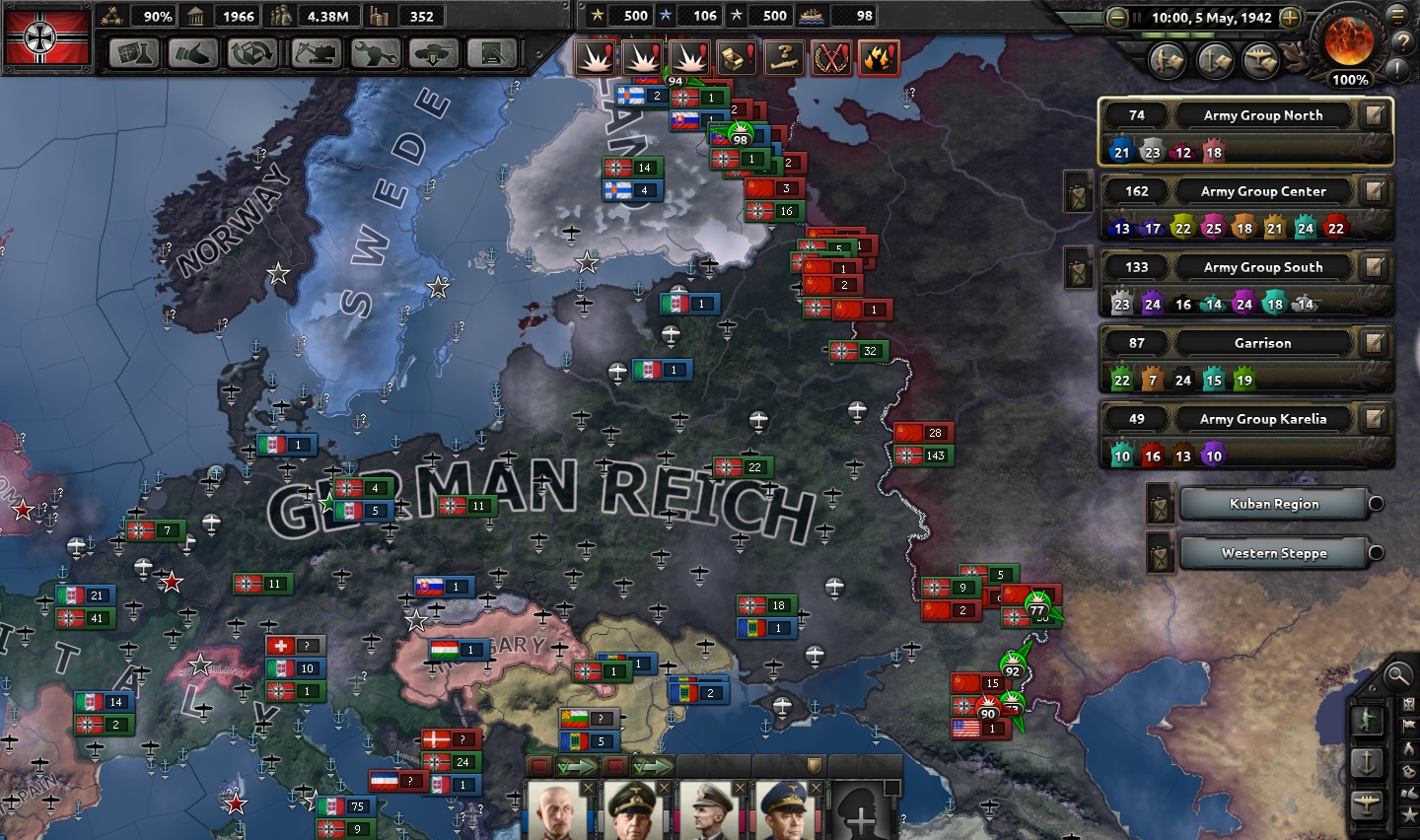
Army Group North has successfully linked up with the Finns, who were struggling to press forward. OKH has assumed control of two Finnish infantry armies, and together with two reinforced Wehrmacht infantry armies has commissioned Army Group Karelia. This is intended to be an ephemeral battle group with the objective of taking full control of the Karelia region and coming to a stop at Arkhangelsk. Recall that this city was the original far left flank of the proposed stop line for Operation Barbarossa. If the army group is successful, we will have shortened our front line significantly and might begin to think about diverting forces back to the west.
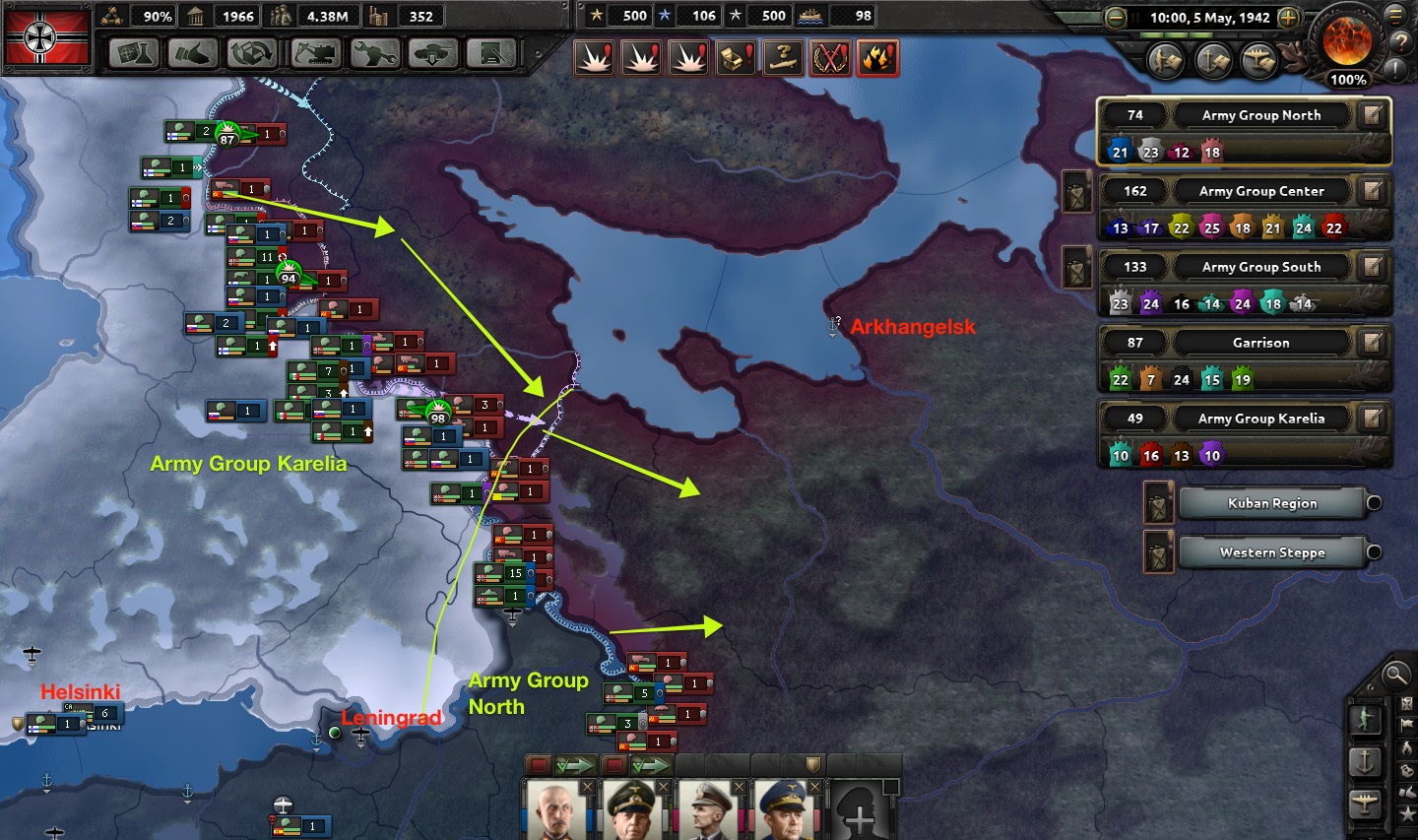
Army Group Center has consolidated its gains around the Moscow area and prepares 1st and 5th Panzer Groups for an encirclement run, with a link-up run somewhere east of Gorki:
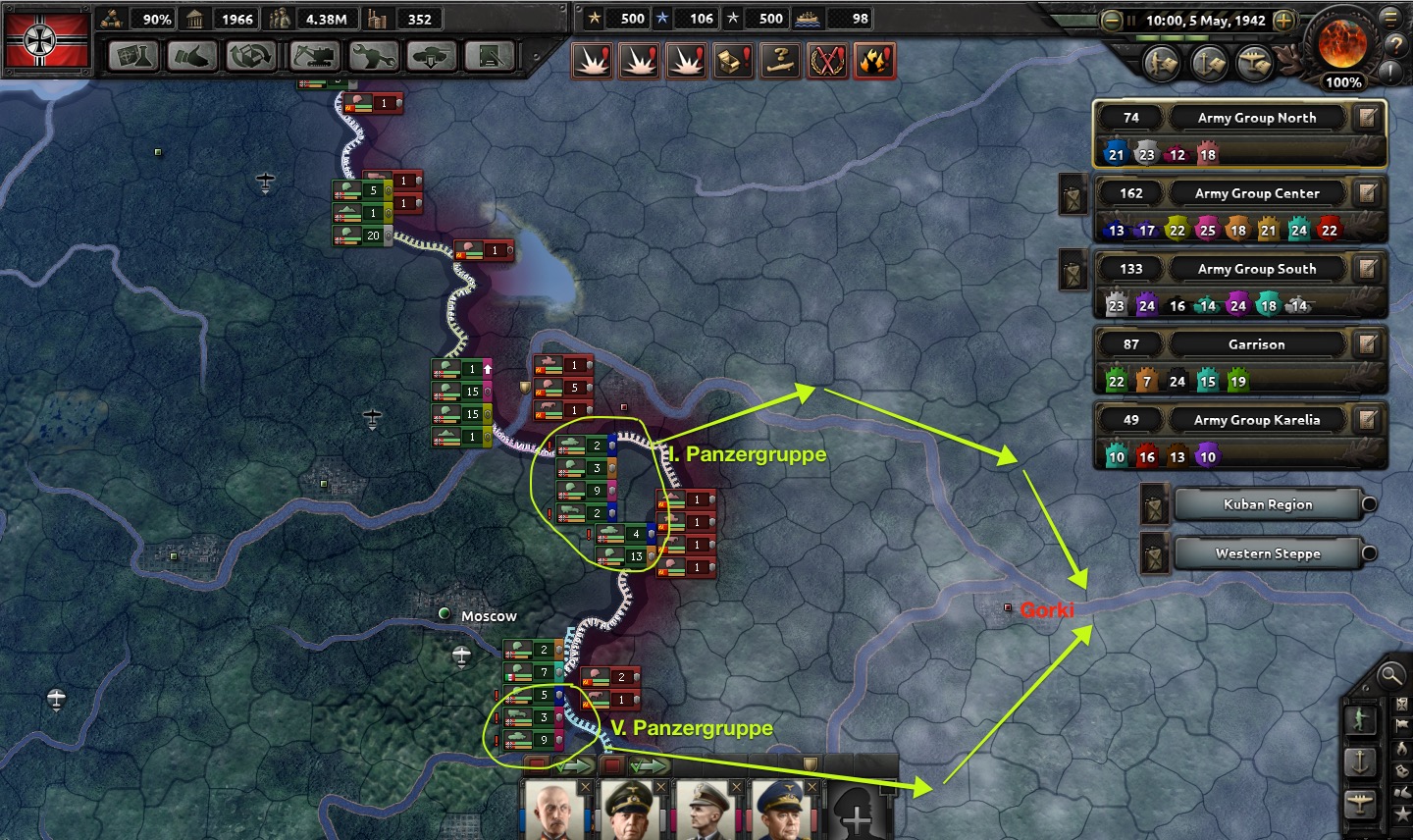
Meanwhile Army Group South has eased into Stalingrad with little resistance with 4th Panzer Group at the forefront, and crossed the Volga. Newly-minted 6th Panzer Group, along with Rommel's 3rd, is fully supplied and ready for an ambitious encirclement run culminating at Saratov (also on the Volga). The 6th (Reinhardt) will skirt along the eastern bank of the Volga to preserve our presence on that side of the river.
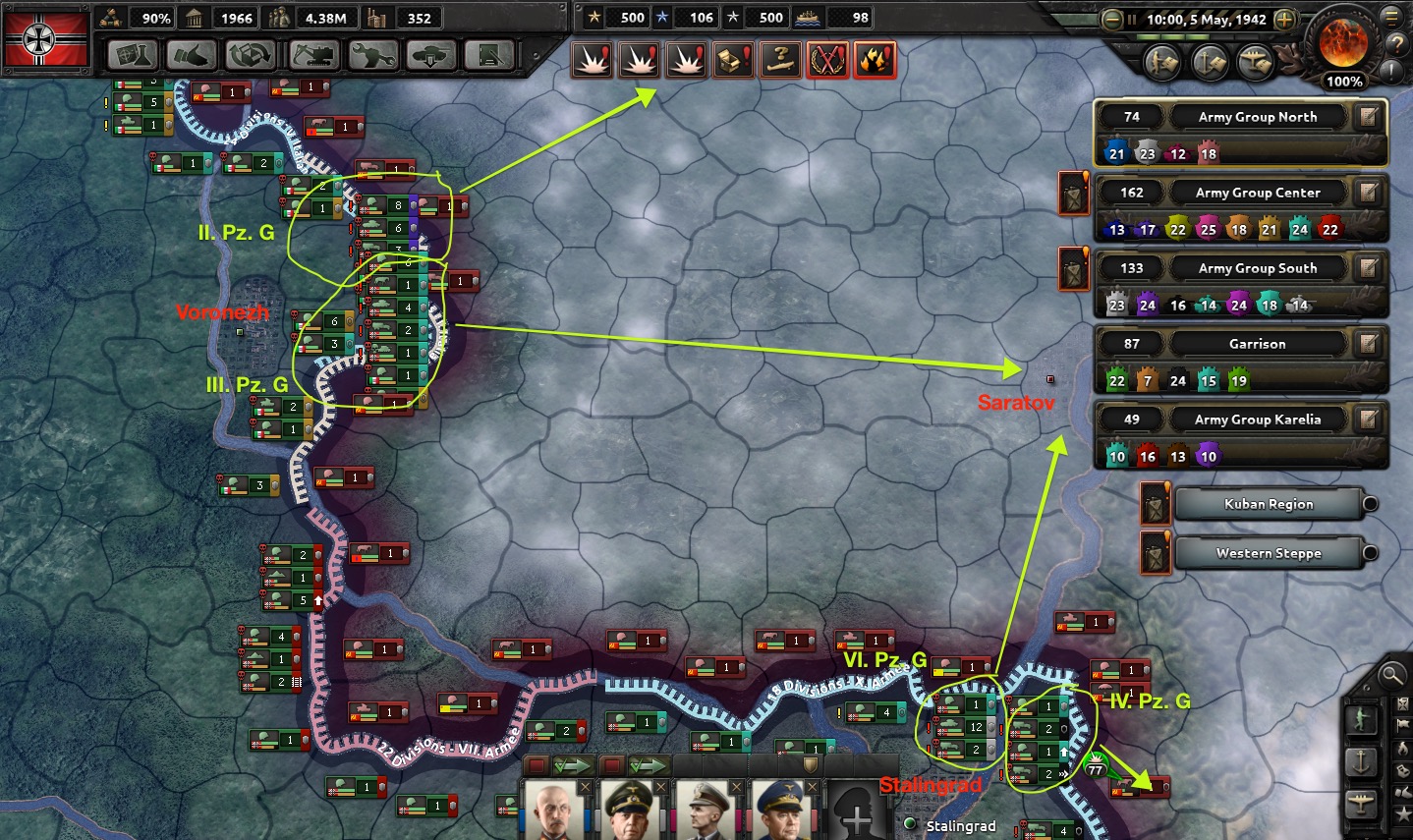
Here's a better look at the situation on the extreme right flank of Army Group South:
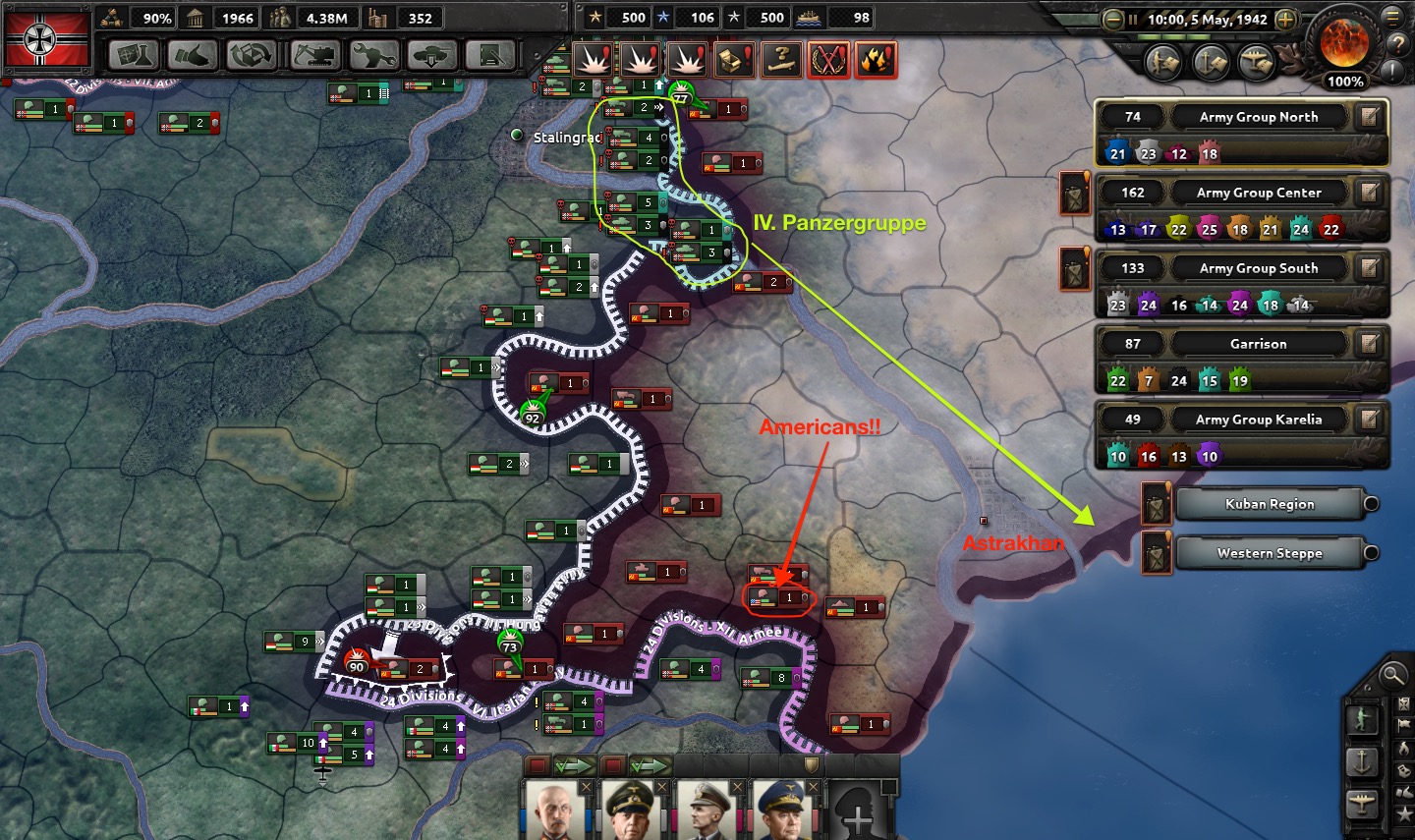
4th Panzer Group prepares to strike out southeast, following the Volga to the Caspian Sea and capturing Astrakhan. This city is the originally-proposed right flank of the Barbarossa stop line. Once the panzers reach the Caspian, we will destroy whatever remains of the Red Army in this area (including an American volunteer division!).
Between late January and May, the satellite armies made their way through Crimea and the Kuban Peninsula into the lower Caucasus region, taking its resource-rich provinces without resistance:
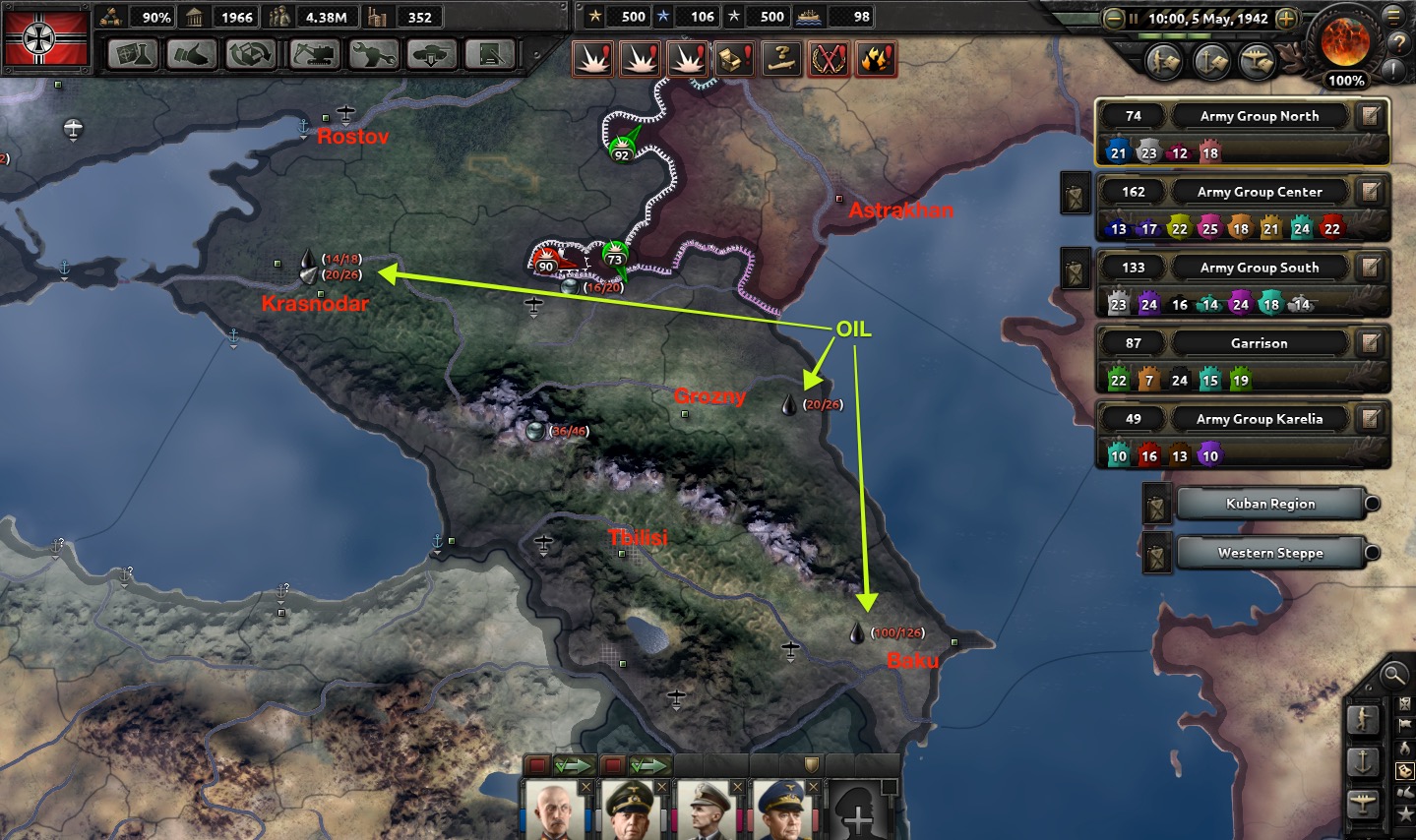
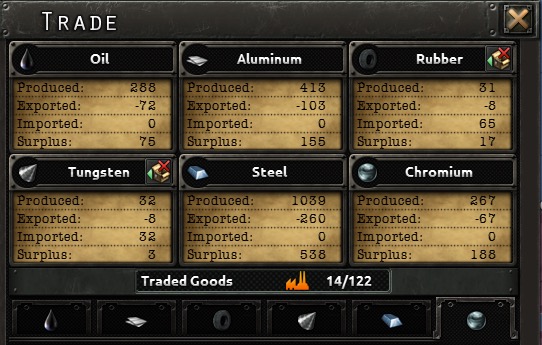
The Reich is now flush with oil, and is now a major exporter of that resource:
The British Problem
With things becoming academic in the East, OKW can begin preparing for a pivot back toward the west. Although OKH still focuses on the problems of today, high command must focus on tomorrow. Operation Sealion will require a substantial reconfiguration of our forces.
Land
Barbarossa required us to build up our land forces to enormous levels. The Wehrmacht is an enormous juggernaut specifically designed for the kind of large-scale mobile warfare it has been carrying out for the past year. We may never again fight a land war on that scale, so we will probably not need to maintain a standing army with six panzer groups, for example. Overall the Wehrmacht currently stands at over 500 divisions, and once we have forces on the ground in the British Isles we may need less than 20% of that to complete the campaign.
Air
Since the liberation of Poland in 1939, the Luftwaffe has been engaged in a non-stop defensive air war against the Allies in western Europe. Overall we have done a good job of keeping their desire to conduct strategic bombing campaigns in the Fatherland at bay, but we have not even attempted to return the favor in the British Isles.
As with the Wehrmacht, the Luftwaffe is a finely-tuned weapon that is designed for tactical bombing and close air support. Until now it has only been a supplementary asset employed in support of the ground-force operations.
Early in World War II, the airplane quickly established itself as the dominant weapon in naval warfare. Battleships became obsolete and carriers ruled the day, as large-scale face-to-face encounters became rare. Because the Reich is so lacking in the naval department, we will take advantage of this development by focusing heavily on the production of naval bombers.
The Luftwaffe has deployed the (weak) naval-bomber wings it has over the channel to get a feel for what is out there:
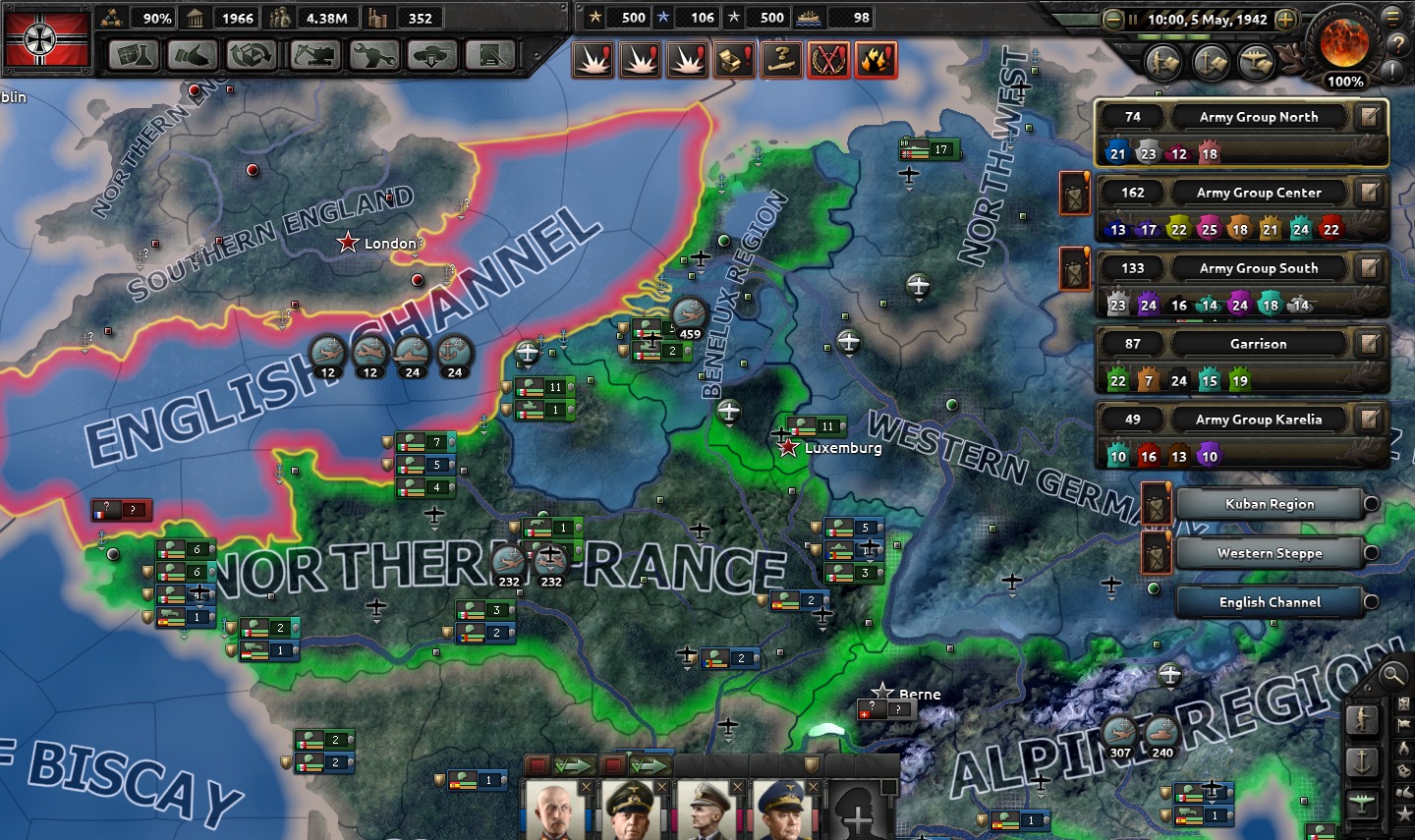
A detailed breakdown:
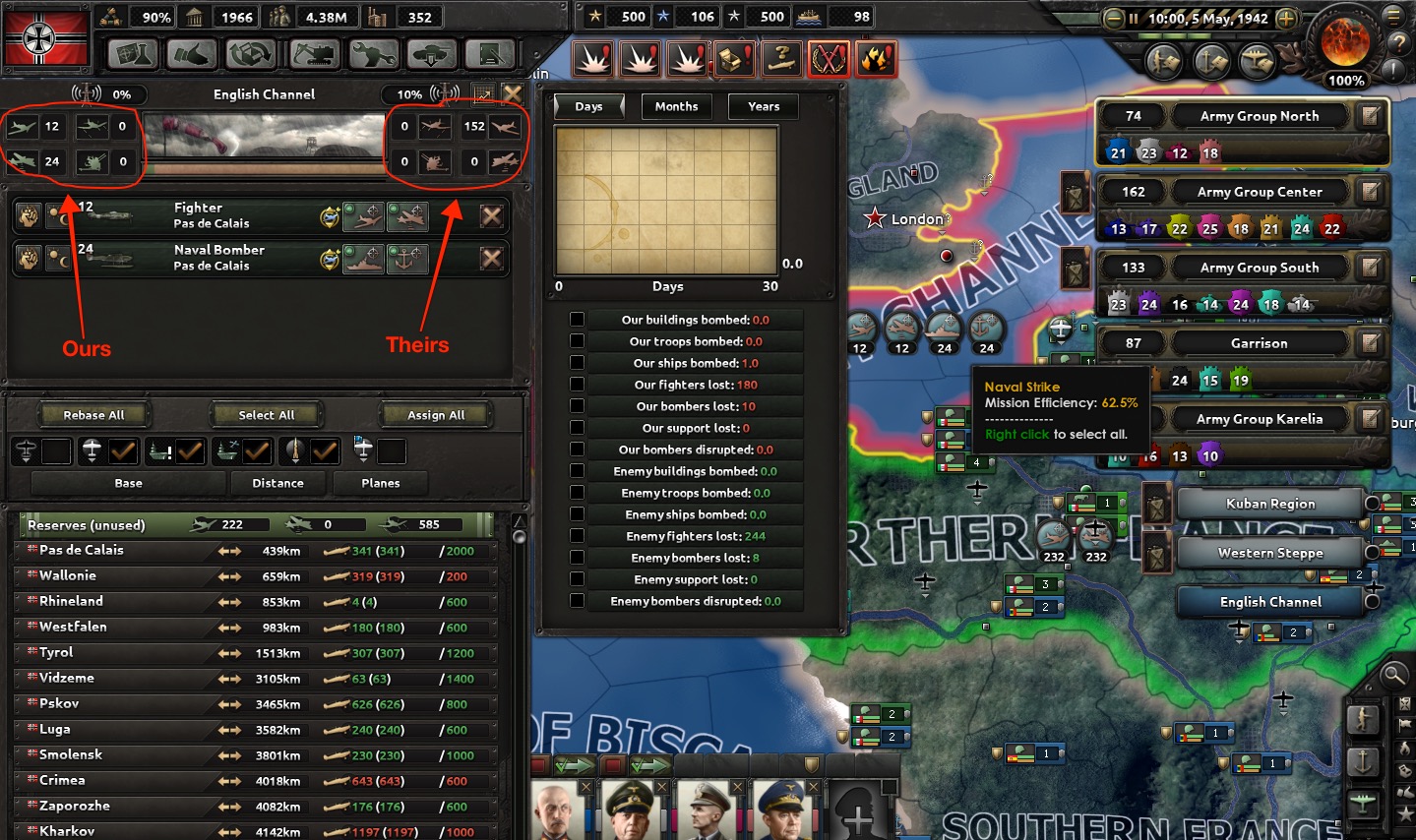
The results are not good so far. The British dominate the skies for the time being, so we cannot give our bombers the freedom to go blow up enemy ships. This will have to change for Sealion to work, because we must whittle down British naval strength in order to have any hope of moving land units across the channel.
The good news is that this is only a temporary situation. A large chunk of the Luftwaffe is still tied up in Russia, so those assets will soon become available to us.
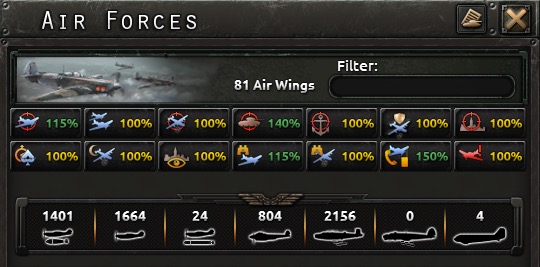
Overall we have about 2400 fighters "in the field" (deployed in active air wings), 2100 tactical bombers, 1400 close air support bombers (Stukas), and change.
We also have a decent number of planes in stockpile (222 fighters, 455 tac bombers, 120 Stukas), so these may be used to marshal new air wings at any time:
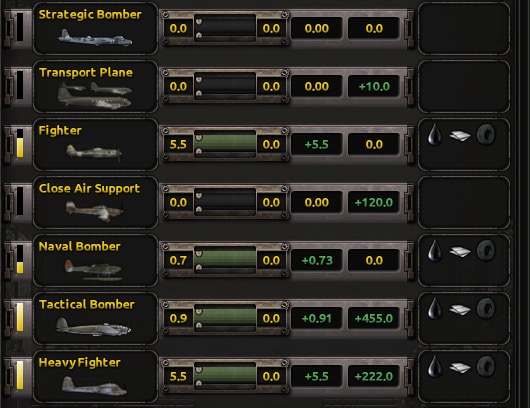
2600 fighters, with such a large bomber contingent, should be adequate to wrest control of the skies from the British.
Sea
The Kriegsmarine has been the neglected arm of the German forces since we started in 1936. We currently stand at:
- 2 battleships
- 7 destroyers
- 7 submarines
The good news is that we have good commanders available, skilled in the art of submarine warfare. The whole of the fleet, such as it is, is in port in northwest Germany proper:
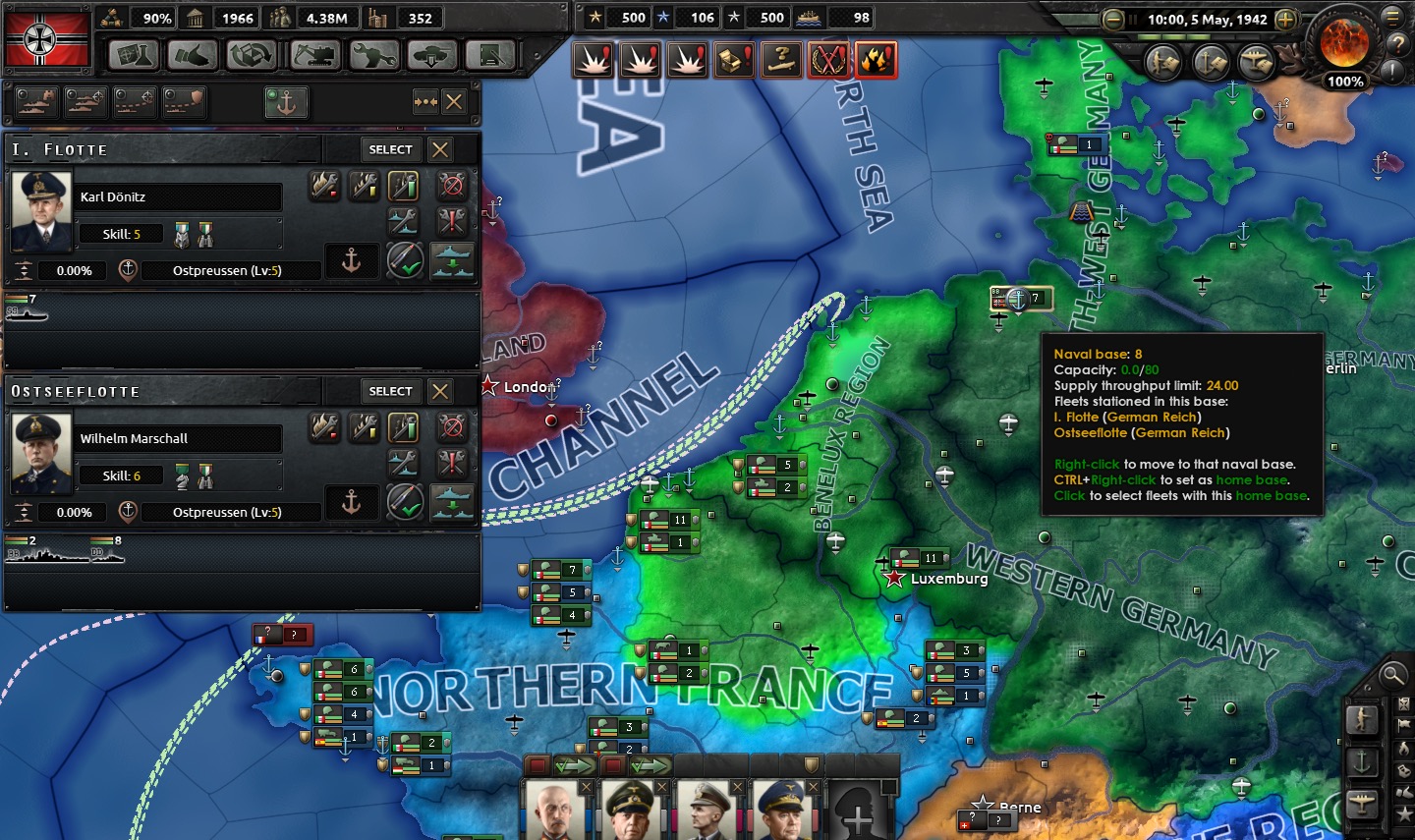
We have 38 operational dockyards at our disposal with which we can construct ships. We have set all of them to work building submarines, which are by far the cheapest and quickest options:
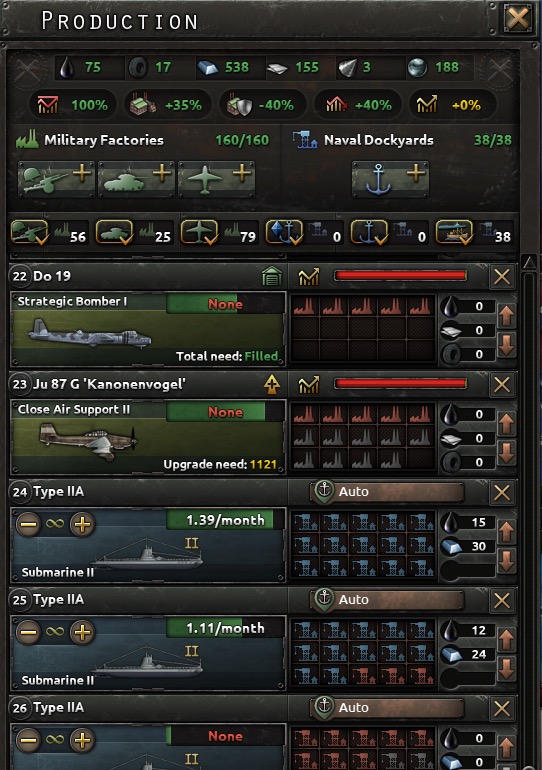
We can produce roughly 2.5 per month, but hopefully we will see production efficiency increases to drive up this rate. A number of our dockyards are also damaged, so repairs should improve our situation as well.
Developments Abroad
OKW can take a renewed interest in developments in areas with the Eastern Front winding down. Unsurprisingly, our allies have gotten themselves into a real mess in Africa:
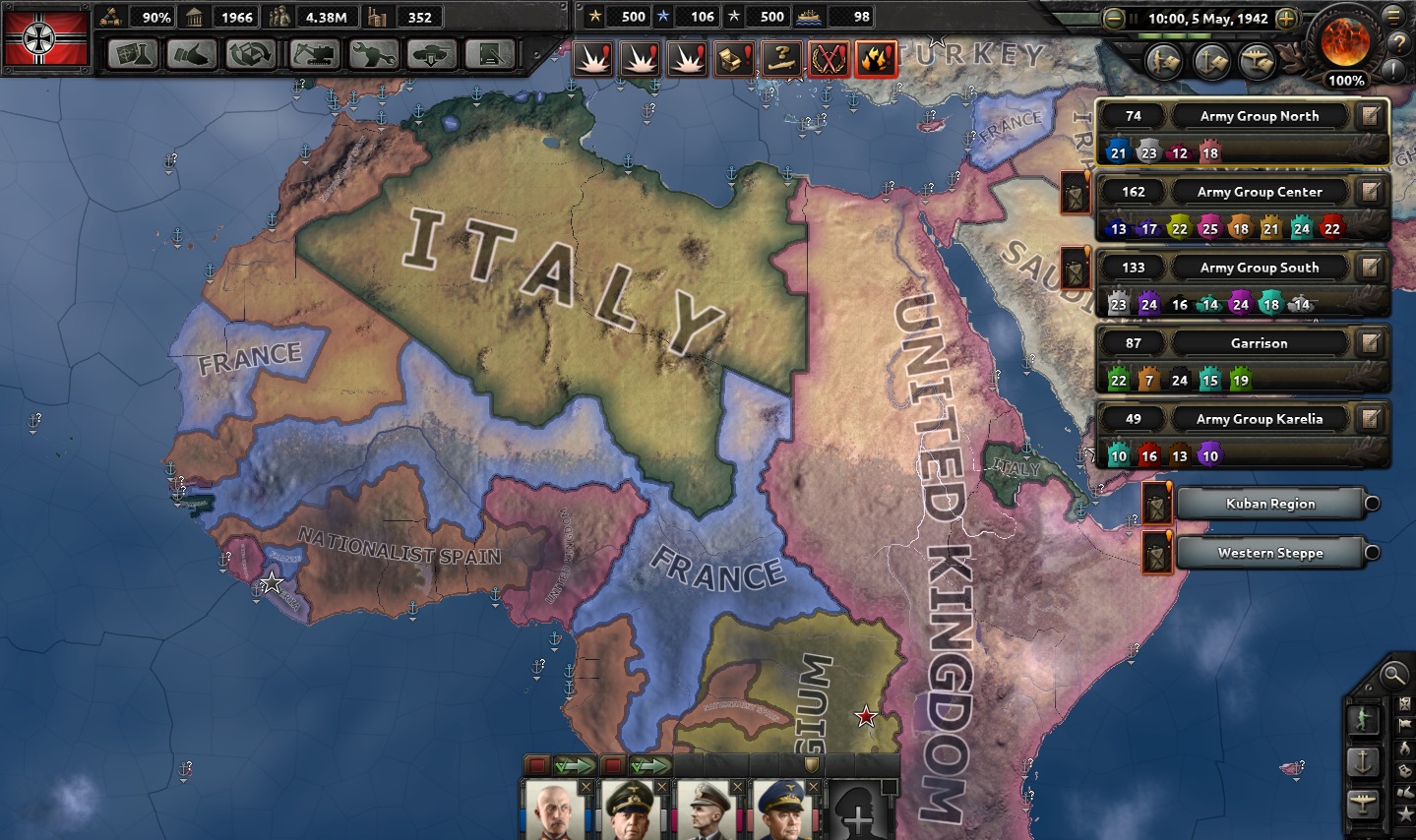
We could put elements of our large panzer force to work in the African deserts to bail out both the Italians and Fascist Spain, but it's not clear yet if Africa has anything to offer us in terms of resources or production-related assets.
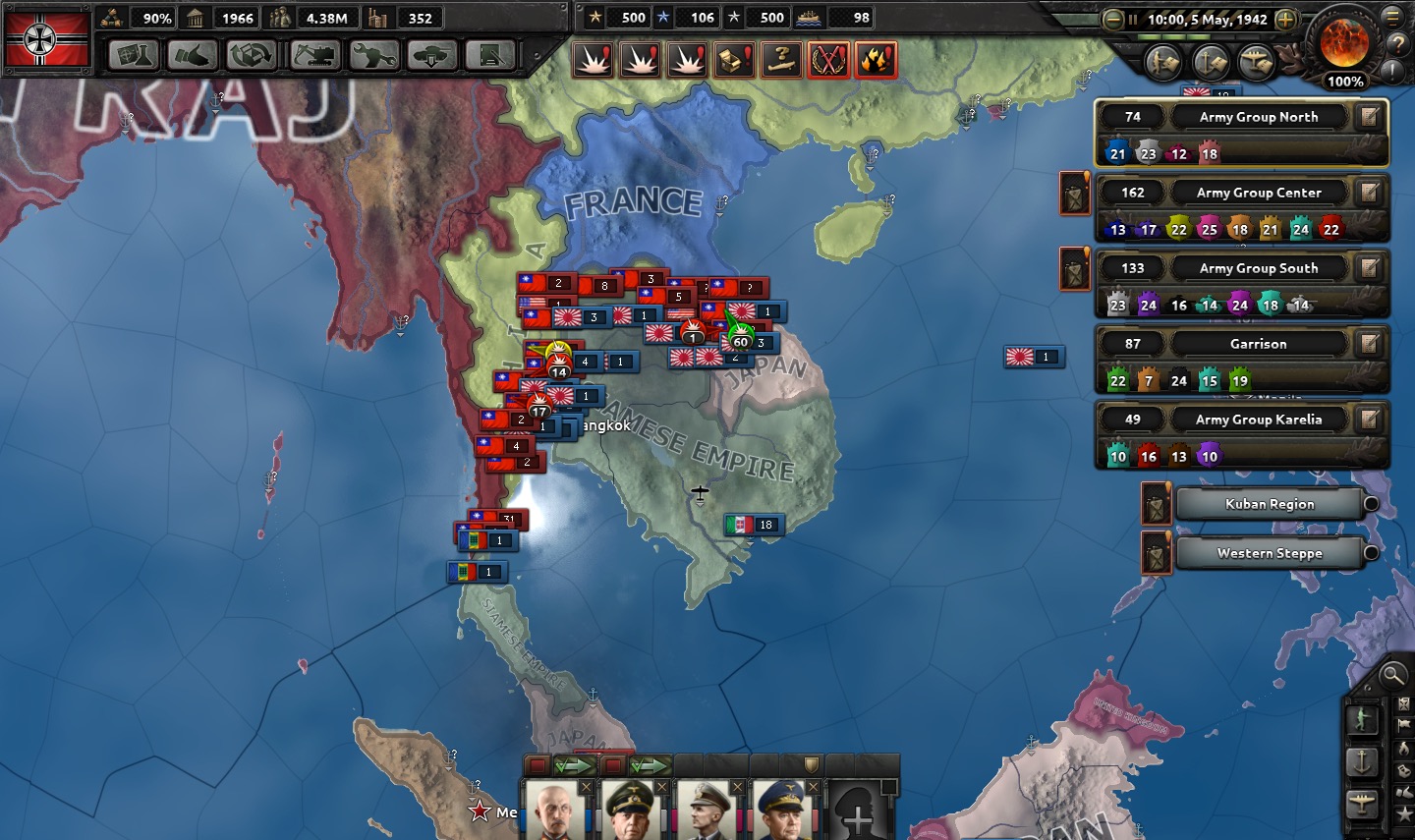
In the far east, the Japanese have long since abandoned all hope of defeating the Chinese and are fighting a losing battle in southeast Asia against the French and British India (among others):
America
The Office of the Foreign Minister has relayed to us the disturbing news that Roosevelt has begun building a case domestically for war with Germany:
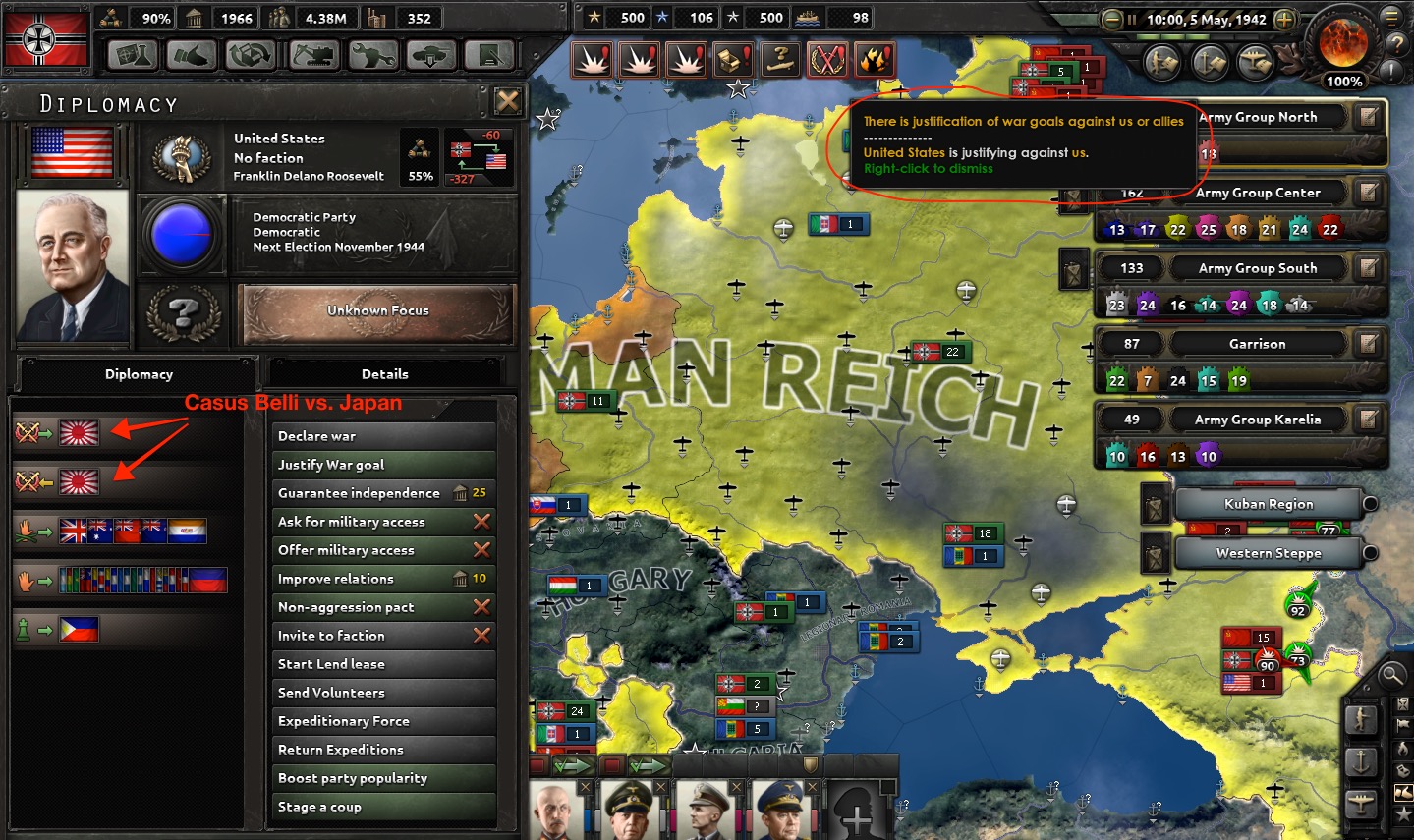
They already have license to go to war with the Japanese should they choose to do so. War with the Americans may not be far off, but we do our best to avoid it until at least the conclusion of Sealion. American entry into the war will make everything more difficult, obviously, but the prospect of a combined British-American naval/air effort is not exciting.